Read this article in 中文 Français Deutsch Italiano Português Español
Honda enters ZTRs with electrics and autonomy

22 June 2026
Honda’s history in the lawn and garden space dates back as far as the 1970s, when it first started researching opportunities in the sector prior to launching its first walk-behind mower in 1978. It continued to expand its lineup from there, introducing residential and commercial walk-behinds as well as a riding lawnmower in 1985.
The company even dipped a toe into automation and electrification early on with Miimo, a compact robotic mower designed for unattended lawn care. Introduced in Europe in 2012 and to the U.S. market in 2017, the battery-powered model utilizes sensors and boundary wire for autonomous operation.
“Miimo was a very important project because it was the first attempt at automated lawn care for Honda. It had varying levels of success in different markets,” said Bradley Adams, public relations, assistant manager, Honda Power Sports & Products at American Honda Motor Company, Inc.
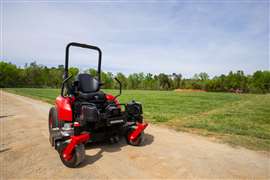 The ProZision electric ZTR family includes 54-in. and 60-in. versions as well as a 60-in. fully autonomous model. (Photo: Honda)
While Miimo now is available primarily in Europe, Adams said, “The electronic systems that were developed for Miimo for things like operating on a hill or load control – those are used on the autonomous product market now. That early development of systems has led into the product that we have now.”
The product he’s referring to is the all-new ProZision Autonomous zero-turn (ZTR) mower, one of the models in Honda’s new ProZision battery-electric ZTR lineup. The ProZision family entered production at Honda’s North Carolina Manufacturing (NCM) facility in Swepsonville, NC, earlier this year.
The new models are the culmination of several years of product development and a complete rededication of a large section of the production facility.
“Because this autonomous mower was entirely new to Honda, our factory wasn’t set up for this, so we had to get the factory on board. We had to get suppliers on board,” said Brian Doklovic, principal engineer and large project lead at Honda. “Every aspect had to be started from scratch, so it wasn’t just [product] development, it was also getting the rest of our systems in line.”
Collaborative, cross-platform design
Reaching the stage where Honda’s first battery-powered ZTRs rolled off the production line in January 2026 was a strategically planned, multi-year process.
“We have systems and practices in place for how we start a new development or a new category,” Doklovic said. “It’s a matter of following those and understanding what the market wants and what the market needs. It’s a methodical approach – step by step by step – and we eventually work through it. It may take a little bit longer, but it’s because it’s all new, it’s fresh. We have to learn first and then we have to train everybody else after that.”
Doklovic had been serving as development project lead for Honda’s new line of battery-powered walk-behinds – which entered production last year – when he was moved over to act as large project lead for the battery-electric ZTRs. “We knew that this product was lacking in our market. We had been working with the DC lawnmowers and essentially from there, [the ZTR] was a natural fit for electrification.”
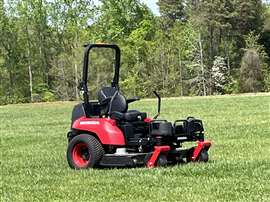 The ProZision Autonomous ZTR can be programmed to mow routes and patterns set using Teaching and Playback modes. (Photo: Becky Schultz)
Extensive collaboration between teams on opposite sides of the globe was involved in bringing not just an electric ZTR solution but an autonomous one to fruition.
“We work a lot with [our Japanese headquarters] in general through our technical committees and through our development aspects and our experts. So, it wasn’t too difficult for us to adapt,” Doklovic said. “We’ve done this for decades, basically, between our U.S. side and the Japan side, working as a team.
The result in this case was the ProZision battery-powered ZTR family consisting of 54-in. and 60-in. “manual” ZTRs as well as a 60-in. fully autonomous model. Built on the same platform as the ProZision 60-in. variant, the ProZision Autonomous ZTR can be programmed to mow routes and patterns set by the operator using Teaching and Playback modes – a feature that you may see applied across other machine platforms.
“We’ve been working on autonomy and autonomous products through our global office – not just ZTRs but through the aspect of our AWV (Autonomous Work Vehicle), so we’ve been sharing that technology across the platforms as well as [exploring] what can we adapt it to in the future,” Doklovic said. “It’s basically sharing the architecture through product lines and sharing the Teaching and the Playback method.”
Taking zero turns to the next level
The new ProZision ZTR mowers have been designed to deliver comparable performance and reliability to internal combustion engine-powered models but with the benefits of battery-electric power.
“Everything is entirely electric on this product,” said Doklovic. “There are five 48-volt brushless motors, three on the deck and two on the wheel motors.”
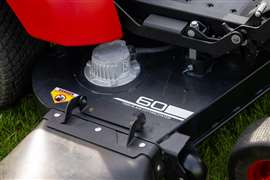 The electric ZTRs utilize three 48-volt brushless motors for blade rotation and two additional motors to drive the wheels. (Photo: Honda)
The decks feature “triple twins” – three sets of MicroCut Twin Blades incorporating stacked and offset blades with 12 total cutting edges for finer clippings. Each of the 3.00-kW deck-mounted motors rotate one set of blades, while the drive wheel motors maneuver the machine.
Six 19.2-kWh lithium-ion batteries provide a runtime of up to 4.3 hours, or roughly 15 acres per charge, depending on the model and conditions. Available onboard chargers offer 120 V or 240 V automatic selecting capability.
“Because we’re focused on battery and runtime and efficiency, we want to make sure that we have enough [charge] to get through the day,” Doklovic said. “We have several patents on these [MicroCut Twin Blades] and the blade tip shapes. We reduce the drag... we’ve actually reduced the motor spindle speed down, but we keep the performance up in this case with the twin blades.
“Mulching eats a lot of electric power,” he continued, “but with two blades, we can get the same cut quality as a mulching blade without recycling [the cuttings] over and over and over.”
A 4.3-in. touchscreen display panel indicates the mower’s operation status and battery state of charge. Selectable drive modes include Rapid, Normal and Precise profiles to match operator control to mowing conditions. Maximum forward speed is 10 mph for manual models or 6 mph for the ProZision Autonomous operating autonomously, and up to 5 mph in reverse.
Other features across the product family include an optimized deck housing for improved airflow and grass movement; 15 cut height settings from 1.5 to 5.0 in.; high/low blade speeds; full mower suspension and adjustable suspension seat; and Ideal Operator Position System that allows the operator to adjust the seat position, drive controls and handles together while moving the seat.
The chassis and main components are constructed from structural carbon steel, with high-strength, low-alloy (HSLA) strategically used in key areas to provide strength while minimizing unnecessary weight.
Autonomy in action
The ProZision Autonomous ZTR is built on the same platform and with the same core features as the ProZision 60-in. model but with a rear rather than side discharge. For autonomous functionality, it has GNSS positioned on the ROPS side of the machine and radar and LiDAR sensors mounted on the front and rear pods.
“From the technology and the safety standpoint, we, of course, have to use two GNSS sensors, because one will just give you position, while two will give you guidance,” Doklovic pointed out.
Omnidirectional sensing with a full 360-degree view via the radar and LiDAR sensors provides for obstacle detection. “The combination of four LiDAR sensors and four radar sensors helps the system maintain awareness of its surroundings during operation.” said Doklovic. “The radars catch you with motion and the LiDAR will catch you with distance.”
Autonomous operation is controlled via the Honda-developed e-User Interface, a web-based platform accessible across a range of devices. “You can [operate] it from a phone. You can do it from a tablet. The landscaper can log into a desktop and he can [monitor] his entire fleet,” Doklovic said.
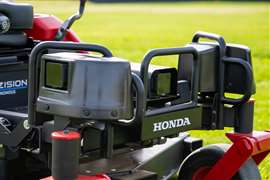 The autonomous model includes radar and LiDAR sensors mounted on the front and rear pods. (Photo: Honda)
Mowing pattern is set through the e-User Interface’s Teaching function – it enables a landscaper to have their best mower operator run the mower in manual mode to establish the route, speed, blade settings, etc. An electronic deck height adjustment system allows the user to easily select the preferred cutting height to achieve the desired cut finish.
Once saved, all preset functions are fully repeatable. “The Playback [mode] will replicate to within 3 cm whatever you taught it,” Doklovic stated. “Literally, it just replicates exactly what you did.”
If conditions change, however, settings can be easily adjusted within the interface.
Other features of the autonomous model include a load control system that automatically adjusts mowing speed to the load and a wheel slip suppression system that independently controls the speed of each drive motor, enabling straight-line tracking and stable operation even on grades or rough ground. There also is a remote stop switch as well as a manual stop switch on the back of the machine for added safety.
Get more done
Honda’s objective in developing an autonomous version of the ProZision ZTR, said Doklovic, was to enable commercial landscaping crews to get more done throughout their workday.
“The point is, with autonomy, [as a contractor] I’m able to do other work. I may be doing trim mowing, maybe I’m blowing, maybe I’m pulling weeds, painting… and the mower is just off doing its own thing,” Doklovic commented. “It’s a time saving device for the landscaper – that’s why we do it. It’s not to take away work; it’s essentially to help your work and get more work done for you.”
Rather than multiple operators in the seat, with autonomy, two or three machines could be working at the same time with a single individual monitoring their operation. “Then you’re just coming up and doing a two-pass cleanup,” Doklovic pointed out.
“[As a contractor], I can get a lot more work done and get on to the next job site,” he stated, “and put a little more money in my pocket.”
POWER SOURCING GUIDE

The trusted reference and buyer’s guide for 83 years
The original “desktop search engine,” guiding nearly 10,000 users in more than 90 countries it is the primary reference for specifications and details on all the components that go into engine systems.
Visit Now
STAY CONNECTED



Receive the information you need when you need it through our world-leading magazines, newsletters and daily briefings.

CONNECT WITH THE TEAM