Read this article in 中文 Français Deutsch Italiano Português Español
Street Smarts: Truck OEMs face hard choices in 2026
28 January 2026
2025 was an “extremely challenging” year for North American carriers and OEMs alike. And according to Moritz Rittstieg, partner, McKinsey & Company, the beginning of 2026 will just be as difficult for OEMs, though he noted there is hope for some degree of recovery in the second half of the year.
 Moritz Rittstieg (left), partner, McKinsey & Company, was among the speakers at CES 2026. (Photo: Jack Roberts)
Rittstieg spoke to North American trucking journalists at the 2026 CES (Consumer Electronics Show) in Las Vegas, Nev., on Jan. 6. He began his talk by noting that truck OEMs are getting hit hard on both the sales and profitability fronts. That’s because the commercial vehicle industry is now expected to fund major technology transitions and retool their operations, even while the core business is under strain.
When truck orders are soft and profit is compressed, big “future investments” become harder to justify, and harder to execute, Rittstieg added.
This is not a situation that will improve soon, he cautioned. OEMs have been basically forced into a defensive posture even as they plan for what comes next.
Lack of investment in new trucks
Moreover, when it comes to unit sales, Rittstieg said McKinsey analysts don’t see any bright spots in the industry that OEMs can lean on to weather the current economic storm.
The problem, he explained, is that the usual obvious “safe harbor” vehicle segments that typically hold up while others soften, such as vocational trucks, aren’t performing well either. This means there’s more to the problem than just the generationally bad freight market stalking the long-haul segment of the industry.
“Economic uncertainty is killing orders more than the lack of fleet profitability,” he said.
Rittstieg said most long-haul carriers have handled the recession well. Many have actively managed costs, tightened operations and right-sized networks – and even parked equipment, as necessary.
But one thing they are not doing is investing in new trucks.
That’s because in an uncertain economy plagued by shifting policy, pricing uncertainty and broader macro questions, it’s simply too risky to pull the trigger on major capital spending. Instead, heavy-duty trucking fleets are slowing their buying and stretching trade cycles.
Pricing problem
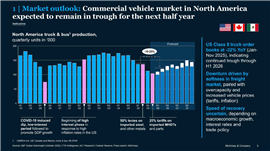
This has created a pricing problem for North American truck OEMs that they can’t easily solve. As Rittstieg explained, the problem is the current “tension” between cost increases and the market’s ability, or willingness, to absorb higher prices.
 Source: McKinsey & Company
In essence, OEMs are hesitant to raise prices because they’re already dealing with weak orders. But tariffs and other cost drivers can force a “price reset” over time, Rittstieg noted. That creates a nasty choice for OEMs: Do they protect margin and risk even fewer orders, or protect volume and take the profitability hit?
“The OEMs have been hesitant to really increase prices,” Rittstieg said, “because they’re already looking at empty order books.”
Yet, if costs continue to rise and price increases lag, OEM profitability will get squeezed even further. Conversely, if OEMs raise prices aggressively, fleets may put off buying new equipment even longer.
Neither scenario is good news for anyone hoping to see the truck market improve soon.
Aftermarket offers bright spot
One potential bring spot is aftermarket sales. That’s because when new truck demand is soft, manufacturers typically turn to what happens after the sale with service and parts support. As such, Rittstieg believes OEMs will place more attention on supporting customers through the aftermarket.
McKinsey has found that roughly one out of every three dollars spent over a truck’s lifecycle happens post-sale. That translates to a steady revenue stream for OEMs when new truck sales are soft.
The strategic play in this instance for OEMs is obvious: Capture more of the money spent on aftermarket parts. This not only generates revenue, it also maintains and strengthens relationships with their fleet customers through enhanced vehicle service and support.
This year, carriers can expect to see OEMs offering more service packages, parts programs, maintenance solutions and other products and services that keep customers in their factory/dealership ecosystem longer.
 Jack Roberts is a Tuscaloosa, Ala.-based independent journalist and licensed commercial driver with more than 20 years’ experience covering the North American and global trucking industries.
Hope for second half
Fleets can only operate older equipment for so long, Rittstieg pointed out, which offers some hope for a recovery in the second half of this year.
“The most likely recovery point for the industry is forced replacement of older trucks,” Rittstieg said. “Eventually, fleets have to replace trucks – not because the outlook becomes crystal clear, but because the equipment can’t be kept in service indefinitely.”
That scenario is more hope than conviction, Rittstieg admitted. But he said it is currently the mechanism on the table to jumpstart a more economically robust trucking industry later this year.
POWER SOURCING GUIDE

The trusted reference and buyer’s guide for 83 years
The original “desktop search engine,” guiding nearly 10,000 users in more than 90 countries it is the primary reference for specifications and details on all the components that go into engine systems.
Visit Now
STAY CONNECTED



Receive the information you need when you need it through our world-leading magazines, newsletters and daily briefings.


CONNECT WITH THE TEAM