Read this article in 中文 Français Deutsch Italiano Português Español
Trendlines: Ag market misery

26 October 2026
Originally published in the October 2026 issue of Power Progress
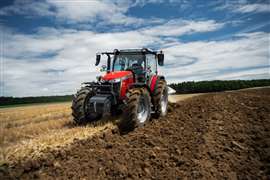 Year-to-date data shows the U.S. tractor market down 14%. (Photo: AGCO)
Monthly data published by the Association of Equipment Manufacturers (AEM) shows that following the exceptional surge in sales from about April 2020 to February 2022, the U.S. tractor market has been in almost continuous freefall ever since. There was perhaps a period in 2023 when retails seemed to have stabilized around the levels seen prior to the pandemic, but the market started to drop in the fall and winter and has done nothing but drop ever since.
Year-to-date (July) data for 2026 shows the market down 14% compared to 2025. If that run-rate continues, the tractor market this year will come in at about 168,000 units. Prior to the pandemic, it was running at about 235,000 to 245,000 tractors per year, while the peak year of 2021 saw 317,000 units sold.
Although the volumes are much smaller, things are looking equally grim for sales of self-propelled combines. AEM figures show the pre-pandemic market to be about 4,800 units per year in the U.S. Sales peaked at 7,450 machines in 2023, but this year the market is heading for a total of about 3,200 machines sold.
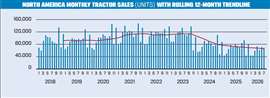 Source: Association of Equipment Manufacturers
Canada has seen a similar boom and bust cycle over the last eight years or so, but the swings have not been so extreme. Tractor sales are running at about 20,500 units this year, 39% lower than the peak year (the equivalent change in the U.S. is a 47% decline) and about 20% lower than the pre-pandemic market (U.S.: 30% lower). Meanwhile, the Canadian combine market this year and last is comparable to the pre-pandemic situation.
Less gloomy picture?
An important caveat to the AEM’s tractor data is that it includes <40-hp machines, which make up the majority of the market. While these are used in small-scale/ specialty farming, the market is also affected by demand from the turf and landscaping world as well as households with acreage.
Stripping these machines out of the data and looking purely at two-wheel-drive tractors above 40 hp plus four-wheel-drive machines paints a less gloomy picture. However, sales in both the U.S. and Canada are still running below their pre-Covid levels and are trending downwards this year (particularly in the U.S.).
Data reflects distress
The market reflects the distress being felt by crop farmers in North America. They have seen years of rising prices for fertilizers, equipment and the cost of borrowing, while revenues have been depleted (paradoxically) by strong production, which reduces price due to high supply, and vanishing export markets due to tariffs and trade tensions.
These factors have still hit home despite various aid programs, such as the Farmer Bridge Assistance (FBA), commodity and disaster subsidies and specialty crop farm assistance schemes in the U.S. and sustainable Canadian Agricultural Partnership (Sustainable CAP) and other grant schemes in Canada. These measures total around US$30 billion, while the One Big Beautiful Bill is said to provide US$65.6 billion (including FBA) over 10 years in tax breaks, reduced bureaucracy and financial safety nets.
POWER SOURCING GUIDE

The trusted reference and buyer’s guide for 83 years
The original “desktop search engine,” guiding nearly 10,000 users in more than 90 countries it is the primary reference for specifications and details on all the components that go into engine systems.
Visit Now
STAY CONNECTED



Receive the information you need when you need it through our world-leading magazines, newsletters and daily briefings.


CONNECT WITH THE TEAM