Read this article in 中文 Français Deutsch Italiano Português Español
When is now for inductive road charging?

08 April 2026
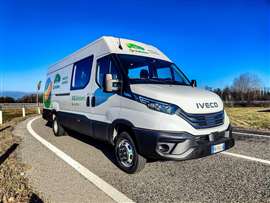 Iveco eDaily fitted with dynamic inductive charging system (Photo: Iveco)
Iveco has unveiled an eDaily window van equipped with both dynamic and static wireless charging capability.
Dynamic wireless charging (DWPT, dynamic wireless power transfer), allows the vehicle to receive recharging power from inductive systems built into the road.
The eDaily fitted with the new equipment will be operated by highway concessionaire Brebemi. According to the report, Brebemi has installed a section of road on the A35 (connecting the Italian cities of Brescia and Milan) with an inductive charging system.
“After nearly a year of testing wireless charging in both static and dynamic modes on the equipped ring at the A35 Brebemi ‘Arena del Futuro’ site - with highly positive results - we seized the opportunity to prepare a new eDaily equipped with the DWPT system,” said Marco Aimo-Boot, Vehicle Electrification – T&D Innovation & Advanced Engineering, Iveco Group.
Various countries are now trialling dynamic road charging systems. In 2025, a 1.5 km section of the A10 in France became the first public road in Europe to deliver charge to moving vehicles. Using tech from Electreon, average power delivery is said to reach 200 kW.
In Germany, the A6 autobahn near Bavaria has had inductive systems added. Wider plans include creation of an electrified road system running from Rotterdam (The Netherlands) in the north to Budapest (Hungary) in the south intended to support trans-continental operation of heavy-duty electric trucks.
In the US, Electreon was involved with the installation of a short 400-meter (quarter-mile) induction charging road in Detroit, while researchers at Purdue University (Indiana) have successfully tested induction charging with Class 8 trucks.
Truck makers are continuing to explore the potential for this technology. A modified DAF XF articulated tractor has been tested with tech supplied by Electreon. MAN Truck & Bus, which has invested heavily in battery tech for heavy vehicles, is part of a consortium looking at the potential for the system.
Future issues
The potential for dynamic inductive charging – different from the static version, where the vehicle takes charge from a pad while parked – is considerable. It could help to support adoption of electric heavy vehicles, which in turn would cut related internal combustion emissions. Further, it could reduce the size of onboard battery packs, the weight of which are already reported as impacting maximum loads in electric HGVs.
There would clearly be some inconvenience when installing these systems within the road carriageway and even customer payment plans are complicated – payment based on automated plate recognition linked to an active account is OK, but there would have to be an opt-out if you didn’t want any charge.
Vinci Autoroutes goes live with ‘Charge as you drive’
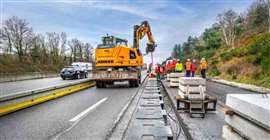 Installation of ‘Charge as you drive’ on the A10 in France (Photo: Vinci Autoroutes)
About 40 km southwest of Paris, Vinci Autoroutes, in collaboration with Electreon, Vinci Construction, Hutchinson and Gustave Eiffel University, has deployed the first dynamic inductive charging system that will operate on a live motorway.
A similar system was implemented in South Korea in 2013, but this was in a dedicated bus lane.
The system on the A10 in France will be for all vehicles, including heavy trucks, buses and passenger cars – any vehicle which has the necessary receiver.
Having installed the transformers to deliver the current and induction coils to create the magnetic field which carries the electrical charge, testing will continue on the 1.5 km stretch of highway to validate the tech.
But the largest barrier comes down to cost. In 2024 it was estimated that converting one mile of road would need about $2 million (£1.6 million). That price has most likely increased over the interim two years.
The investment-per-mile might come down as more highways have the feature added, but then there is also the cost of the electric trucks. While no official numbers are available, these vehicles are estimated to be about three times the price of a standard diesel model – although smaller battery packs would reduce that figure.
With the pace of change in the vehicle power market, it’s possible that other technologies could make inductive road charging obsolete – solid state batteries have the potential to erase the need for charging on the go, while battery swap systems are popular in China. That could leave companies and government agencies out of pocket as equipment buried in the road returned little of its initial investment.
The technology behind dynamic inductive charging is ready for rollout. The question remains whether there is the motivation to install the systems and invest in the vehicles that can use it.
POWER SOURCING GUIDE

The trusted reference and buyer’s guide for 83 years
The original “desktop search engine,” guiding nearly 10,000 users in more than 90 countries it is the primary reference for specifications and details on all the components that go into engine systems.
Visit Now
STAY CONNECTED



Receive the information you need when you need it through our world-leading magazines, newsletters and daily briefings.

CONNECT WITH THE TEAM