Read this article in 中文 Français Deutsch Italiano Português Español
Flash Battery adds new module assembly line
03 September 2026
Italian battery specialist extends in-house capabilities to support further product customization
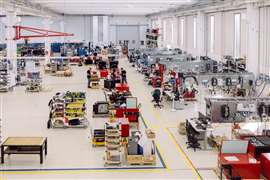 Production site at company headquarters in Sant’Ilario d’Enza, Italy (All photos provided by Flash Battery)
In the heart of Italy’s Po Valley, between Milan and Bologna, lies the town of Sant’Ilario d’Enza, home to the recently extended headquarters of Flash Battery, a company which specializes in the production of lithium-ion battery packs.
“We specialise in customized batteries, so we look for niche markets that require expertise, customization and related consultancy,” said Marco Righi, Flash Battery’s CEO and founder. “The company produces batteries for a wide range of applications, including construction, agriculture, cranes, ariel platforms and AGVs (automated guided vehicles). We focus on medium to large batteries, starting from 10 and up to 200 kWh.”
According to Righi, 65% of the products manufactured by Flash Battery are for the Italian market. The remaining portion is shipped to other European markets, including Germany, France, Spain and Scandinavia. To support the growing North American market, in 2023 the company opened a new site in Houston, Texas, dedicated to aftersales service.
Laser welding modules
In January 2025, Flash Battery invested more than €6 million to expand its Italian headquarters. This included 2,200 square meters dedicated to an automated laser welding installation. According to Righi, the expansion will double the existing module production capacity of 90,000 units per year.
 Marco Righi, CEO and co-founder, Flash Battery
Righi: “In order to be able to produce customized products, we decided to keep everything internal. All the electronics have been designed in-house, including the firmware, then we moved on to software development with our predictive maintenance system. All the mechanical components are designed here, as is the entire cabling system.”
Continuing, he says that Flash Battery used to buy the finished modules from a supplier. The decision to invest in the in-house assembly line was largely to build expertise and move further up the supply chain. Righi says that they will continue to buy in the battery cells: “[These] will never be in our remit, as enormous volumes would be required.”
Eighteen months after the automated assembly line was launched, Righi says the results have been positive. “We’ve reorganised workflows, improved production planning and logistics. This has achieved financial benefits, because we now skip a step in the supply chain.
“We used to buy 15 different modules. Now we buy three types of base cells and create all15 module types in-house. That supports greater customization and we’ve made some improvements to the final products, including greater resistance to vibration and impacts.”
Predictive analysis
Production of the modules has been shaped by development of the battery management system (BMS). “We actually call it a battery balancing system because it manages to keep the batteries at the same level to maximize efficiency,” says Righi.
In 2015, a remote data collection system was added. He notes that unlike other systems, this reads information directly from the vehicle’s onboard components and that data is then sent to the cloud. It includes charge and discharge information that allows faults to be recognized in real time, but as Righi says, that means the customer can also see the fault.
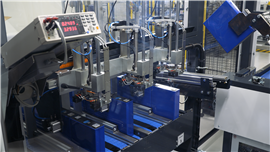 Individual battery cells are loaded into modules - these are later combined into packs
“We analyze data on a daily basis,” he says. “Even while everything is running perfectly, we are able to spot deviations that may indicate a problem. Seeing these before they become critical issues allows us to plan maintenance, carry out remote updates or change a setting. Or we can advise the customer to use the machines differently. This predictive analysis keeps the battery working and reduces costs to the customer.”
The data can be used to support development of next-gen products. But that follows on from development of new battery chemistries and the ability support an increased number of charge/discharge cycles. Righi said that at the moment it’s not feasible to analyze each individual application type to where he can guarantee a given level of lifetime performance.
“The chemistry is very delicate. A battery’s life expectancy depends on the machine’s design, how you use it, temperatures, how you charge it, either quickly or slowly. There are so many factors simultaneously in play that it’s almost always impossible to simulate them.
“We are working on creating digital twins so that we can better determine longevity and intervene before the chemical composition is compromised. Using machine learning algorithms and now artificial intelligence, we are trying to develop specific predictive models for each application, tailoring those to different sectors.”
Constant evolution
The introduction of European gigafactories dedicated to LFP (lithium iron phosphate) cell production is a promising idea, according to Righi.
“We can’t wait, because it would mean shortening the supply chain even further. But all the European gigafactories that were due to open have been put on hold, except for those under Chinese ownership. I expect they will be the first to succeed in bringing European-made cells to market.”
While cells are now sourced from some well-known companies, Righi believes a fully European supply chain can deliver advantages in an era of rapid geopolitical change. “The impact [of change] on our market has been to slow down the drive towards electrification and sustainability. This has undoubtedly stifled a sector that was on a growth trajectory.”
Look to the future
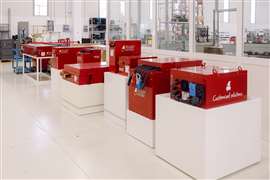 Finished battery packs produced by Flash Battery
Despite this slow down, battery technologies are continuing to evolve. “Solid-state batteries would, among other things, improve safety and support faster charging,” says Righi. “But we will have to wait until at least 2030 for this, and the tech was primarily designed for the automotive sector, not for industry.”
He says that another new trend is sodium-ion batteries. They’re now found most commonly in energy storage, although these are also starting to appear in the automotive sector. But he says that this particular chemistry is unlikely to feature in products now using power solutions from Flash Battery.
In addition to new chemistries, there are other issues. The EU Batteries Regulation, which will come into effect as of February 2027, is a directive which will require the addition of a ‘digital passport’ to every new battery pack. The goal is to improve transparency, traceability and sustainability, as the information will include battery state of health and which materials have been used, which will help with end-of-life recycling.
The regulation will apply to batteries used in electric vehicles, e-bikes/scooters, and industrial batteries with a capacity of more than 2 kWh.
Meanwhile, Flash Battery is looking to improve the performance of its products. “We are continuing to develop the third generation of our BMS, which will bring even more benefits, as we seek to understand even better how these cells work,” said Righi.
With an expected launch date in 2027, the new BMS will include the capability to measure cell impedance to help better understand the condition of individual cells. “We are always looking ahead and deliver the batteries and systems of tomorrow,” said Righi.
POWER SOURCING GUIDE

The trusted reference and buyer’s guide for 83 years
The original “desktop search engine,” guiding nearly 10,000 users in more than 90 countries it is the primary reference for specifications and details on all the components that go into engine systems.
Visit Now
STAY CONNECTED



Receive the information you need when you need it through our world-leading magazines, newsletters and daily briefings.


CONNECT WITH THE TEAM