Read this article in 中文 Français Deutsch Italiano Português Español
INTERVIEW: Dean Thornewell, MD at LiuGong UK

16 July 2026
LiuGong UK boss speaks with Power Progress at the Hillhead machine show about new machines and growing markets
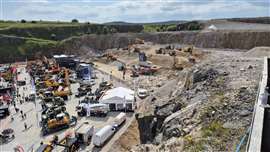 Demonstration area at Hillhead 2026 (Photo: Power Progress)
Guangxi LiuGong Machinery, known around the world as simply LiuGong, is a Chinese company which produces a broad range of machines designed for use in various heavy industry sectors. The company produced its first wheel loader in 1966 and these machines remain central to the product lineup; it is reported that LiuGong is still one of the world’s largest wheel loader manufacturers.
Founded in 1958, LiuGong has been extending its reach beyond the home market well before the current collapse of the housing market in China (and other extenuating factors) prompted many companies to do the same. LiuGong now sells equipment in about 170 countries around the world, while operating assembly plants in India, Brazil, Argentina and Indonesia.
One of the most significant moves was the purchase of the Polish company HSW Dressta in 2012. This gave LiuGong a European base and direct access to the EU market. This includes the UK, where the company operates one of its dedicated R&D centers.
New models on show
Dean Thornewell has been managing director at LiuGong UK since 2024. He spoke with Power Progress at the Hillhead machine show in Derbyshire in June, on a very busy company stand. Asked what was drawing visitors to the LiuGong pitch, he highlighted the new additions to the model range.
“We’ve launched a series of new models; there are 10 UK model debuts here today. And I think the UK construction industry is starting to take interest in the battery-electric (BE) story. The construction industry, quarrying, they’re looking to benefit from our expertise in battery-electric machines.”
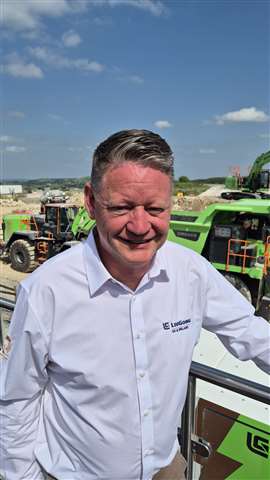 Dean Thornewell, MD of LiuGong UK at Hillhead 2026 (Photo: Power Progress)
A little background on the LiuGong machine electrification journey is probably warranted here. A related R&D program was started in 2014 which resulted in the unveiling of the company’s first BE machine prototype in 2018 – the first models included a wheel loader (as might be expected) and an excavator.
The commercial launch of the first electric 856HE wheel loader came in 2020, targeting operators working on low-emission, low-noise sites. By 2023, the company was offering those machines in Europe, at which point it is reported global sales had reached more than 3,000 units. Since then, BE variants of many machine types have been introduced, including excavators, mining trucks and what is said to be the world’s first electric surface grader.
Of course, the elephant in the room when it comes to battery-electric machines is the high initial cost of those models. But Thornewell says that looking at it from just that perspective misses the point. “The key thing is total cost of ownership. As soon as we discuss that with customers, they see that their operating costs are going to be 40, possibly 50% less than a comparable diesel model and that return on investment will make up for the initial cost.”
Thornewell adds that it’s not just an electricity-versus-diesel issue. He highlights how electric machines have considerably fewer moving parts and this can reduce related maintenance costs and deliver extended machine uptime.
Sounds great, but Thornewell admits it’s not a broadstroke solution: “It’s not for everyone, we know that. But with our application focus as a business, we can look at the role the machine needs to play and give the customer the right solution. Sometimes it’s a diesel, sometimes it’s electric. I’d like to say we give expert advice off-site and then prove what we said on site.”
Electric power goes big
The commonly-held wisdom is that BE power solutions are better for smaller machines. These models use the power more efficiently, while the smaller battery packs both cost less and are faster to recharge.
LiuGong would beg to differ with this view. At Hillhead, the company brought together the 8110TE wheel loader, DR50CE rigid mining truck and 4280DE motor grader working together as an electrically-powered fleet. These were supported by fast-charging systems from partners Vital Power Group and DENS.
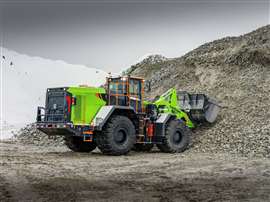 LiuGong 8110TE battery-electric wheel loader (Photo: LiuGong)
Looking at just the 8110TE, this is a 41-tonne wheel loader which features a 706 kWh LFP (lithium iron phosphate) battery pack. Recharging at up to 720 kW, a 12 to 95% charge can be completed in around 60 minutes. The pack is liquid cooled to maintain an optimum temperate range.
“I think it’s interesting how our machine designs have evolved,” said Thornewell. “We’re now on the fourth and fifth generations of our electric machines. We’ve been through the design-and-test loop multiple times. And the battery tech, the chemistries supplied by CATL, means we can package more power into bigger machines and that delivers the needed run times.
“Considering the recharging times, you’re not that far away from the time it takes to fill up two or three machines from a diesel bowser,” he added.
The intent was a clear demonstration that battery-electric power is no longer only for smaller, lighter machines. But there’s more.
Thornewell: “Customers visiting our stand at Hillhead can see that the machine is only part of the story. They want confidence in the people, the parts, the service and the support. That’s where we’re continuing to build real momentum in the UK. We want to meet customers face-to-face, listen to what they need and show them the solutions we’re putting in place.”
Market differences
Moving away from specific machines, the conversation turned to look at the difference between customer requirements - even customer expectations - in different countries and regions.
“When you look at some European markets, Germany, France, etc., they’re much more mature than some markets in Asia,” said Thornewell. “We find that UK and European customers are very demanding in terms of operator comfort. That includes functionality, a great joystick response improving ease of use. But also the size of the cab, climate control and a comfortable seat. The cabins can be pressurized to reduce dust ingress.
“We’re now on the fourth and fifth generations of our electric machines. We’ve been through the design-and-test loop multiple times. And the battery tech, the chemistries supplied by CATL, means we can package more power into bigger machines and that delivers the needed run times” Dean Thornewell, LiuGong UK
“In Asian markets, that’s not so important. Of course, those features are still there, but perhaps not executed to the same level.”
New technology also feature more highly in European markets, but in large part that comes down to the price of the machines and expectations that the price will include the most advanced systems available.
TRA investigation
Launched in 2023, a TRA (Trade Remedies Authority) investigation was launched to look at whether excavators imported from China were being dumped on the UK market at lower prices that harmed national manufacturers. The investigation followed an application by JCB.
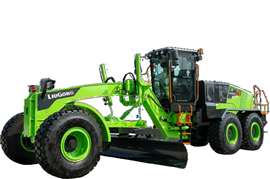 Battery-electric 4280DE grader from LiuGong (Photo: LiuGong)
Specifically, the investigation looked at three points: whether China-built excavators were being sold at below their normal value; whether UK manufacturers had suffered as a result; and whether anti-dumping duties would be in the overall economic interest of the UK.
Following the investigation the TRA concluded that dumping had occurred and in May 2025 implemented duties ranging from 18.81% to 40.08% (a residual rate). In response, LiuGong argued that battery-electric machines should not have these charges as they are a distinct product category. At the same time, Caterpillar challenged the calculations of the TRA and requested a revision of those numbers.
In July of the same year, the TRA announced it would uphold its original decision. But the case was notable as it raised the question of whether battery-electric machines should be considered separately from diesel-powered models.
“We went through the investigation with the TRA, proved that our costs, our overheads were as they should be and that we were delivering machines at a legitimate price,” says Thornewell. “There were no subsidies or other support keeping our prices lower. We were just operationally more effective. There was a small tariff, but we’ve moved past that now.”
Asked whether the UK government should be doing more to promote the uptake of battery-electric machines, Thornewell explained that there’s a place for machines using all types of power – and that the market will continue to offer those varied power solutions for the foreseeable future.
“It doesn’t matter if it’s diesel or HVO, electric or hydrogen being used to generate electricity. There’s a place for all of those. But as long as the UK continues to advance its environmental goals, we’ll all eventually get to a greener industry.”
POWER SOURCING GUIDE

The trusted reference and buyer’s guide for 83 years
The original “desktop search engine,” guiding nearly 10,000 users in more than 90 countries it is the primary reference for specifications and details on all the components that go into engine systems.
Visit Now
STAY CONNECTED



Receive the information you need when you need it through our world-leading magazines, newsletters and daily briefings.

CONNECT WITH THE TEAM