Read this article in 中文 Français Deutsch Italiano Português Español
PCQ Technologies gives designers freedom, reduces downtime

29 September 2026
Window, windshield technology meets standards without limitations of glass
As its name suggests, PCQ Technologies is a technology company. The innovation in which it specializes can give design freedom to engineers of a wide range of mobile machinery. Its polycarbonate windshields and windows can get a proprietary coating to meet automotive standards in the United States and Europe, and they can be seen in applications ranging from motorcycles to last-mile delivery vehicles. Marine, agricultural, forestry, mining and other off-highway equipment are next.
“Plastic?” It’s a question that PCQ Technologies President Barry Willey has heard often from design engineers, and he’s ready for it. The company has made hundreds of thousands of windshields and in doing so has removed most of the hurdles that stood between an equipment operator and a long-lasting, unbreakable window to the world.
It’s not just any plastic. The company uses specialized tools – many designed and built in-house – to form its windshields from optical-quality polycarbonate sheets. It’s the material that made compact discs a popular way to enjoy classic tunes such as “The Motorcycle Song” from Arlo Guthrie.
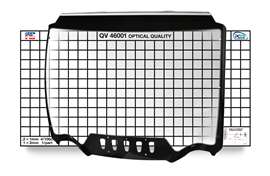 A large windshield made by PCQ Technologies sits in front of the company’s Optical Inspection Grid. (Photo: PCQ Technologies)
“There are several myths around the use of polycarbonate,” said Willey. “The biggest one is that it turns yellow. Sure, uncoated polycarbonate will, but that’s not true as a general statement. Dealing with black specs embedded in the material is another one, but we use only optical-quality sheets. When compact discs came on the scene in the 1980s, the polycarbonate companies added capacity for their ultra-pure optical polycarbonate. CD sales are way down today, but now we have access to tons of optically pure polycarbonate at a good price.
“The next thing they’ll say is, ‘It will be wavy and I can’t see through it.’ Back when the manufacturers’ polycarbonate machines ran off gears, they’d clog and embed lines into the sheets. Well, now the polycarbonate manufacturers have new extrusion machines with AC servos that are totally dialed in. The sheets we buy are beautiful. There are no waves. They’re crystal clear.”
Permanent scratches created by hours upon hours of windshield wiper use and other sources were another challenge for plastic, and that was a significant hurdle the company passed in the mid-1990s. Launched in 2000, its proprietary Quantum hard coating process has been applied to tens of thousands of its windshields and canopies for motorcycles, side-by-sides and, lately, battery-electric last-mile delivery vehicles. The company is now offering a follow up process it has branded Quantum+.
“Quantum+ coating forms a type of silicon carbide on the surface so it’s harder than glass and gives it a hydrophobic reaction,” said Willey. “In rain, water groups together in channels so most of the windshield stays clear.”
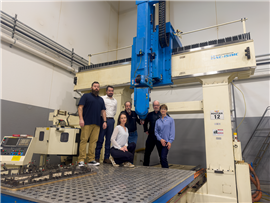 National Cycle and its division PCQ Technologies remains a family-run company. In this photo, from left to right, are: L to R Tyler Willey, CNC technician; Derek Willey, tool room manager; Suzanne Willey, OEM sales engineer; GB Willey, senior project manager; Barry Willey, president; Ann Willey, aftermarket sales manager. The company was founded in 1937 by Gordon Willey, Barry’s father. (Photo: PCQ Technologies)
Two-wheel test mules
“For us, the secret is not just the coating, however; it’s the molds and the materials and the techniques that we’ve perfected,” said Willey. “We’ve paid for those lessons over the years.”
PCQ Technologies – the initials stand for Polycarbonate Quantum – launched three years ago as a division of National Cycle Inc. Located in Maywood, Ill., the family-run company was founded in 1937 by Barry’s father, Gordon Willey. Initially called Nation’s Cycle Center, the company found a niche in making and selling headlights, mirrors, luggage racks and other fabricated parts through motorcycle dealers. Its aftermarket product line grew quickly thanks to an unwavering focus on the customer.
The factory was next to his parents’ house, and Barry Willey grew up with the company. “During the 1960s, a local Harley dealer contacted us,” he said. “The motorcycle windshields of the day were made from thin vinyl with a bead around the top to stiffen it. That worked for a long time because bikes were barely going 50 mph.
“The dealer said, ‘These darn Harleys are going over 60 mph, and they’ll even hit 100 mph now, and the windshields are caving in.’ They needed something stronger. I was attending the University of Illinois in Champaign at the time. I saw when Neil Armstrong went to the Moon, he had a face shield made from Lexan polycarbonate, and from there I started researching and talking with suppliers. Being in Chicago, we were in the center of the world with a great supplier base.”
That was the beginning of National Cycle’s move into the windshield industry. In 1975, the company said it became the first in the world to use GE’s Lexan FMR brand of polycarbonate material in motorcycle windshields. It began supplying them to motorcycle OEMs at that time and those relationships have expanded since then.
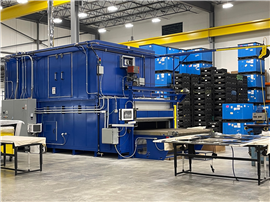 One of PCQ Technologies’ large format ovens for forming big windshields. (Photo: PCQ Technologies)
Under the microscope
“When I look at my top line, we have 250 years of combined experience making windshields,” said Willey. “When you’re working with an OEM as a Tier 1 supplier, you’re under the microscope.”
That microscope helped make the company vertically integrated to ensure quality and on-time delivery. Tour the sprawling factory in Maywood today, and the creation of windscreens, cab tops and windows dominates the production floor.
The company does much of the work in-house, including silk-screening. It said the application of Quantum hard coating on top of a silk-screened feature means OEM names and logos do not fade or wear off over time.
Metal fabrication still occurs in Maywood, as well, albeit in smaller numbers and often as a value-add for window work. The company can do laser cutting, bending, stamping and more. A team of metal polishers is kept busy giving rough steel a mirror-like finish.
With an eye toward automotive applications, its windshields have passed the United Nation’s ECE 43R M1 certification that allows polycarbonate windshields to be used with wipers, as well as Z26.1 AS1. Published by the American National Standards Institute (ANSI) and SAE International, it is the highest safety glazing classification in the U.S. and is required for laminated windshields in cars, trucks and buses. FMVSS 205, the federal motor vehicle safety standard that governs glazing materials in all vehicles sold in the U.S., requires AS1 in the windshield position.
“Our windshields with our Quantum hard coating can be used in any position on any road,” said Willey. “We’ve got the first monolithic layer of polycarbonate to ever do that.”
Two summers ago, the plant expanded in square footage and machinery to support the larger windshields that PCQ Technologies quotes.
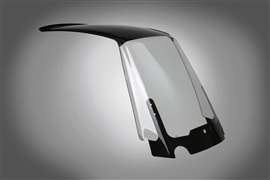 The roof and windshield are one piece in this example from PCQ Technologies. (Photo: PCQ)
Designed for polycarbonate
Glass is made from melted sand, while polycarbonate is made from oil. As such, the price difference between the material types is one remaining hurdle when the up-front cost is the only consideration.
“We’ve done a number of jobs where we eliminated the A and B pillars,” said Kevin Surufka, engineering manager for PCQ Technologies and National Cycle. “You can eliminate all of the pillars and make a bubble. That starts with a sheet of polycarbonate as big as a table, but with parts consolidation we save money.
“Off-highway equipment makes a lot of sense for our windshields, because you don’t want to have downtime due to broken glass. When polycarbonate gets hit with a rock or a branch, you’re not going to be out of service. The combine can stay in the field, and the mining equipment can keep operating.”
“I’d like to get the marketing guys to get behind the lifetime cost of a machine and then turn this technology into a customer satisfaction improvement story,” said Willey. “And they can have a cab that looks like nobody else’s cab.”
 The factory in Maywood, Ill., has been expanded to make room for the work PCQ Technologies quotes in marine and on- and off-highway vehicle applications. Photo: PCQ Technologies)
The family business
Suzanne Willey grew up with the business like her father, Barry Willey. Today, she is the OEM sales engineer for PCQ Technologies and rarely looks at a windshield. Rather, Suzanne looks through them.
“We make windshields the way Tiffany makes jewelry,” she said, “and the way Waterford makes its crystal. After visiting us in Maywood, you will never look at a windshield the same way again. Nobody’s doing it the way we do it.”
In a meeting, she pointed to photos taken during the unveiling of a light commercial vehicle. Through the windshield, the background appeared as a series of wavy lines. “This is their show vehicle,” she said. “That would not even get out of our shop – ever. Maybe they’re just not up to date. We’re going to correct the record. You can have unbreakable windshields that are FMVSS 205 compliant.
“They could be driving Ford F-150s with our windshields, but the best use of polycarbonate isn’t as a direct replacement to glass. Vehicles look the way they do because of the limitations of glass. With our windshields, you can form corners and do all kinds of innovative designs because it’s not going to break. You can redesign the cab to take advantage of the characteristics of polycarbonate, which is extra strength, better visibility and weight reduction.”
POWER SOURCING GUIDE

The trusted reference and buyer’s guide for 83 years
The original “desktop search engine,” guiding nearly 10,000 users in more than 90 countries it is the primary reference for specifications and details on all the components that go into engine systems.
Visit Now
STAY CONNECTED



Receive the information you need when you need it through our world-leading magazines, newsletters and daily briefings.

CONNECT WITH THE TEAM