Read this article in 中文 Français Deutsch Italiano Português Español
Street Smarts: Volvo Takes Truck Technology Off the Pavement
09 November 2026
There was a time when the recipe for a vocational truck seemed pretty straightforward: Build it tough. Give it plenty of power. And make sure it could take whatever punishment the job dished out.
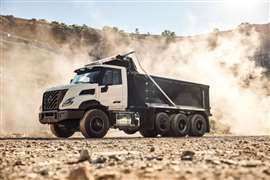 Volvo VNX 300 Dump: Volvo’s VNX expands the definition of a capable vocational truck. (Photo: Volvo Trucks)
Those requirements haven’t gone away, of course. A dump truck still has to climb out of a muddy excavation site. A logging truck still has to handle rough roads with a heavy load. And a concrete mixer still has to get into places that weren’t necessarily designed with a Class 8 truck in mind.
But Volvo’s new VNX suggests that the definition of a capable vocational truck is expanding. Strength remains essential. Increasingly, though, Volvo believes technology is helping determine how effectively that strength gets put to work.
A bigger role for vocational
If you love new trucks – and who doesn’t? – Volvo has been well worth watching over the past couple of years. The VNX completes a sweeping renewal of the OEM’s entire North American truck lineup.
Volvo launched its VNL on-highway tractor in 2024 and followed up with the launch of its new VNR model in 2025. Now, with the new VNX in its stable, Peter Voorhoeve, president of Volvo Trucks North America, said all three trucks share a common platform developed through a $3 billion investment in product development and manufacturing.
This common platform, he added, gives Volvo a way to bring technology developed for its highway trucks into applications where the operating challenges can be considerably different.
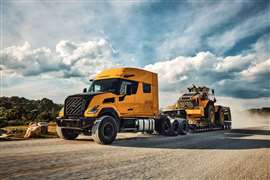 The new VNX is offered as a daycab, a 42-in. sleeper and a 62-in. mid-roof sleeper, with both axle-forward and axle-back configurations. (Photo: Volvo Trucks)
Voorhoeve has long maintained that Volvo enjoys a stellar reputation in Europe as a builder of tough, reliable vocational trucks. The new VNX is intended to extend those capabilities into the North American vocational market, as well.
The VNX will be offered as a daycab, a 42-in. sleeper and a 62-in. mid-roof sleeper, with axle-forward and axle-back configurations. Applications range from concrete and municipal plowing to logging and heavy-haul highway work.
Under the hood is Volvo’s D13 rated up to 540 hp and 1,950 lb.-ft. of torque. The company also lists up to 630 braking horsepower – an important consideration when the job involves bringing a heavy load down a grade.
Heat-treated steel frame rails, a protected metal grille and multiple steel bumper configurations address the physical demands of those applications. A clean layout behind the cab gives body builders room to easily and quickly make modifications.
Taking the controls outside
Perhaps no new feature on the VNX showcases Volvo’s commitment to technology better than the Remote Steer feature.
Remote Steer is instantly recognizable to anyone who has ever played a video game. A remote-control system allows operators to control the truck from outside the cab at speeds up to 5 mph. Mixers, cranes and vacuum units are among the potential applications.
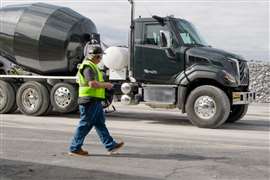 The Remote Steer feature allows operators to control the VNX from outside the cab at speeds up to 5 mph. (Photo: Volvo Trucks)
Remote Steer makes sense, Volvo engineers said, because a good deal of vocational truck work involves moving the vehicle short distances with very little margin for error. Being able to control that movement from a position outside the cab gives operators the ability to view the truck’s progress from a safe vantage point, while giving them an accurate perspective of the environment and the vehicle’s proximity to the buildings and jobsite around it.
Safety shere the work happens
Volvo’s safety approach also recognizes that a jobsite presents challenges beyond those found on an interstate.
Workers and equipment operate close to trucks. Conditions change. Drivers have to divide their attention among the vehicle, the load and everything happening around them.
 Jack Roberts is a Tuscaloosa, Ala.-based independent journalist and licensed commercial driver with more than 20 years’ experience covering the North American and global trucking industries.
That’s why Voorhoeve said the new VNX includes standard forward pedestrian detection. Optional blind spot detection covers both sides, with visual and audible warnings under specified conditions involving a pedestrian alongside the truck or trailer.
Volvo Dynamic Steering – which debuted with the new VNR last year – is another feature with obvious jobsite benefits. Dynamic Steering gives drivers heightened electronic control of the steering system. This helps reduce steering effort and maintain control on uneven ground. Over a long day of maneuvering, the value of reducing driver strain deserves consideration alongside horsepower and payload.
Connectivity rounds out the new VNX package, with a factory-installed telematics gateway supporting Remote Diagnostics, over-the-air programming and Volvo Connect fleet reporting.
Volvo began accepting orders for the VNX on Oct. 26, 2026.
POWER SOURCING GUIDE

The trusted reference and buyer’s guide for 83 years
The original “desktop search engine,” guiding nearly 10,000 users in more than 90 countries it is the primary reference for specifications and details on all the components that go into engine systems.
Visit Now


CONNECT WITH THE TEAM