Read this article in 中文 Français Deutsch Italiano Português Español
Why has China seen strong 2025 demand for BEV HDTs?
08 April 2026
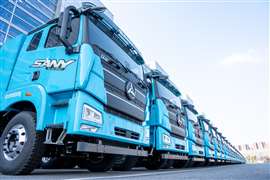 While policy has helped create the conditions for electrification, economics have accelerated BEV HDT adoption in China. (Photo: Sany)
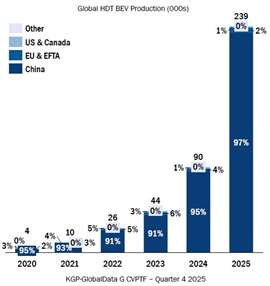
In 2025, China did not just lead the global market for battery-electric heavy-duty trucks (BEV HDT), it dominated it. Global BEV HDT demand more than doubled year-on-year to around 239,000 units, with China accounting for more than 95% of global volumes. Momentum accelerated further into the final quarter, with electric trucks representing 20%, 24% and 28% of China’s total heavy-duty production in the last three months respectively.
Economics driving rapid adoption
Policy has helped create the conditions for electrification, but it has been economics that accelerated adoption in 2025.
Unlike in Europe, where tightening CO₂ regulations and zero-emission freight zones are driving compliance-led adoption, China’s BEV HDT surge has been largely economics-led. Battery costs continued to decline throughout 2025, while improvements in energy density allowed for longer ranges without proportionally increasing pack size.
CATL’s scale has played a central role. The company holds over 70% of the battery pack market in China’s BEV HDT segment. Combined with China’s vertically integrated battery supply chain, this has helped reduce input cost volatility and compress vehicle pricing.
The 2025 trade-in scheme also had a significant impact. Higher subsidies were offered to replace older State III and State IV trucks with compliant new energy vehicles, with a maximum subsidy of ¥140,000 per vehicle. This incentive pulled forward demand that might otherwise have been spread over several years, accelerating fleet renewal.
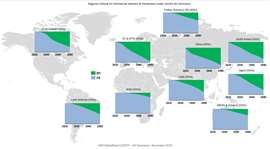
Registered new energy trucks also benefit from toll fee reductions or exemptions on national expressways and provincial toll networks, further improving operating economics.
As a result, in suitable duty cycles, the total cost of ownership for HDTs is now estimated to be 20% to 30% lower than that of comparable diesel vehicles. Combined with more stable electricity pricing relative to diesel’s exposure to global oil markets, BEVs have shifted from being policy-driven alternatives to commercially rational investments.
Structural foundations supporting electrification
While economics ultimately triggered the surge in demand, China’s broader policy and industrial landscape has helped enable this transition.
Under the Dual Carbon Agenda, the country aims to peak carbon emissions before 2030 and achieve carbon neutrality by 2060. For heavy-duty transport, that inevitably implies a gradual shift away from conventional diesel.
Provincial and municipal governments have translated these national targets into concrete measures. Ports are increasingly required to adopt new energy vehicles, electric cargo handling equipment and charging infrastructure as part of green certification criteria. Pilot logistics parks and industrial zones must ensure that internal vehicle movements are electric or hydrogen-powered to qualify for government support, with operators adopting BEV trucks often receiving priority for infrastructure funding.
Several major cities have also introduced urban freight zones restricting diesel trucks. In Beijing, for example, large areas of the city now operate as zero-emission freight zones where only electric- or hydrogen-powered trucks are permitted during daytime hours.
At the national level, the Ultra-Low Emission (ULE) campaign for heavy industries has added further momentum. The policy requires up to 80% of goods transport in regulated sectors to be conducted via clean modes such as rail or waterways. Where road freight remains necessary, low-emission vehicles – increasingly zero-emission HDTs – are expected to take their place.
Importantly, this transition is also supported by developments in China’s power system. The country is now the global leader in renewable energy deployment, with wind and solar capacity rising 22% in 2025 to reach a record level. This rapid build-out strengthens electricity supply in key industrial regions, lowers wholesale power costs in many areas and improves energy security, factors that directly support the large-scale electrification of HDTs.
Compared to diesel, electricity pricing in China is also less exposed to global commodity volatility, as power prices are largely influenced by domestic generation and regulated tariffs rather than international oil markets. For fleet operators, this provides greater long-term cost stability and reduces exposure to oil price swings.
Electrifying freight therefore aligns not only with climate targets, but also with China’s broader industrial strategy, reinforcing domestic clean energy supply chains while reducing reliance on imported fuels.
Can growth continue?
The key question now is whether this pace of growth can be sustained.
While the trade-in scheme has been extended into 2026, its impact is expected to be moderate. The pool of remaining State III and State IV trucks eligible for replacement is shrinking, limiting the scale of further stimulus-driven demand.
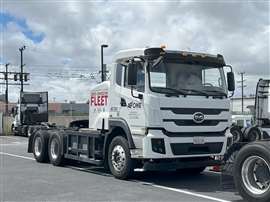 While urban applications continue to offer growth opportunities for Chinese suppliers, long-haul accounts for roughly 70% of the market in Europe and around 65% in North America. (Photo: Becky Schultz)
Adoption is also concentrated in specific regions and applications. BEV penetration is strongest in short-haul operations and in provinces with large urban centers focused on improving air quality. Shanghai alone accounted for more than 15% of BEV HDT volumes in 2025, with over 34,000 units. Guangdong followed with more than 12%, while Shanxi accounted for nearly 8%.
As short-haul distribution, refuse collection and other urban applications become increasingly electrified, growth is likely to plateau in these segments.
China’s heavy-duty market structure has also been particularly conducive to BEV adoption. Estimates suggest that only around 10% of heavy-duty activity involves long-haul routes above 500 km, while approximately 55% is urban, covering distances of 0 to 200 km. By contrast, long-haul operations account for roughly 70% of the market in Europe and around 65% in North America.
This distinction has been central to China’s rapid progress. Shorter, predictable routes with return-to-base charging are well suited to battery-electric trucks. However, long-haul applications remain more challenging. Achieving ranges above 500 km requires very large battery packs, increasing vehicle cost and reducing payload capacity. These technical and economic constraints are likely to limit BEV penetration in certain segments.
Alternative pathways for decarbonization
Battery-electric trucks are unlikely to represent the sole pathway for decarbonizing China’s heavy-duty fleet.
Hydrogen continues to attract attention, particularly as a potential long-term solution for higher energy density applications. Scaling domestic green hydrogen production could enhance energy security and reduce reliance on imported oil and gas. A five-year fuel cell demonstration program began in August 2021 and runs until August 2026, supporting early deployment.
Fuel cell electric vehicles accounted for 0.9% of total HDT production in the final quarter of 2025, compared with 0.1% in the first quarter of 2025. While this represents gradual progress, a significant market ramp-up is unlikely before 2030 due to ongoing challenges around hydrogen production, storage, refueling infrastructure and cost. A newly launched national hydrogen pilot scheme across 11 key areas, covering the full value chain, is expected to be operational by 2028.
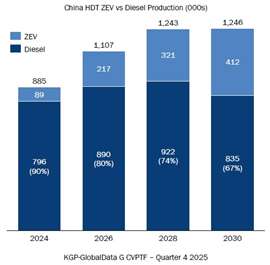
Natural gas trucks also remain part of the mix, accounting for more than 16% of total HDT production in 2025. Volumes rebounded strongly from August onwards, supported by trade-in policies in key provinces and new engine launches offering greater power and displacement. Relatively low domestic LNG and natural gas prices, influenced by cheap Russian pipeline gas, have improved the total cost of ownership for gas-powered trucks. However, the natural gas market faces structural limits in regions where infrastructure is already mature and penetration is high.
Methanol has similarly been highlighted as a domestically producible alternative capable of reducing dependence on foreign oil. Several manufacturers have begun developing methanol-powered heavy-duty engines, supported by China’s large domestic methanol production capacity and existing industrial supply chains.
Hybrid powertrains have also seen renewed interest, particularly in applications where full electrification remains challenging. For some operators, they offer a practical transition technology, reducing fuel consumption and emissions while maintaining operational flexibility.
Conclusion
Despite the exceptional growth seen in 2025, a modest fall-back in BEV HDT demand is expected in 2026 as stimulus effects fade and early adopter segments mature.
Over the medium to long term, China is likely to pursue a multi-fuel pathway to meet its carbon targets, with battery-electric dominating but hydrogen, natural gas, methanol and hybrid technologies playing complementary roles.
Alternative fuels are expected to be particularly important in long-haul distribution, where higher energy density requirements, extended range needs and payload constraints may limit the suitability of battery-electric trucks.
China’s 2025 surge in BEV HDTs therefore reflects more than short-term policy support. It reflects the convergence of climate policy, strong domestic battery and energy infrastructure and improving total cost of ownership, conditions that have allowed electrification to scale rapidly in segments where it makes both operational and economic sense.
Luca De Nunzio is a data analyst for KGP Powertrain Intelligence. All analysis and forecasts referenced in this article are based on KGP’s CV Powertrain Forecast, which provides detailed outlooks on commercial vehicle production, powertrain mix and technology adoption across key global markets.
POWER SOURCING GUIDE

The trusted reference and buyer’s guide for 83 years
The original “desktop search engine,” guiding nearly 10,000 users in more than 90 countries it is the primary reference for specifications and details on all the components that go into engine systems.
Visit Now
STAY CONNECTED



Receive the information you need when you need it through our world-leading magazines, newsletters and daily briefings.


CONNECT WITH THE TEAM