Read this article in 中文 Français Deutsch Italiano Português Español
Zapi Group builds its electrification ecosystem

29 December 2025
Founded in 1975 in Poviglio, Italy, Zapi Group is a global electrification company that encompasses multiple brands and a range of electrification components for low-voltage to high-voltage applications in material handling, e-mobility, robotics and automation.
In early August 2025, Zapi Group announced the acquisitions of two more companies: SMPC Technologies (SMPC), a Canadian firm specializing in power electronics, and Stercom Power Solutions, an intelligent charging and energy storage systems provider based in Germany.
 Rod Dayrit (Photo: KHL Staff)
Power Progress sat down with Rod Dayrit, global director, Business Development Lead of Zapi Group Charging Solutions, and Rahul Baliga, vice president, Integration at Delta-Q Technologies, to discuss the strategy behind these acquisitions and what they mean in terms of products and services the group can offer to OEMs and other customers.
Q: Electrification has become a very crowded space. What is Zapi Group doing as a company to set itself and its products apart from other players in the market?
Dayrit: Zapi Group [is] a culmination of product and service companies. The whole premise around the group is to provide an ecosystem of product offerings – essentially a system-based solution to our customer base. We are operating in three of the major regions across the globe: North America, Europe and Asia. We have a manufacturing footprint which is global.
One of the things that really sets us apart is we’ve had electrification in our DNA since the beginning... It’s always been focused on that, and our core competency is going to continue to innovate with electrified products and build more within the ecosystem of our offerings, whether it’s products, components or services…
Some companies have product offerings to compete against us, but they don’t offer the other piece of the puzzle, and the commitment from the founders [to] continue to expand those offerings so that it makes the most optimized and efficient sense to the customer base or to the marketplace.
Q: How does SMPC Technologies and Delta-Q fit into this strategy?
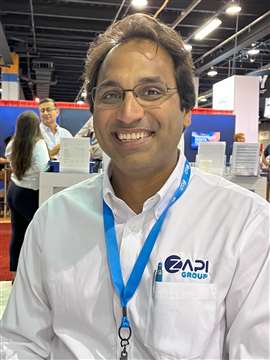 Rahul Baliga (Photo: KHL Staff)
Baliga: I come originally from SMPC. We’ve known Delta-Q for many years now. While we were SMPC, we were to a certain degree competitors… The way I saw Delta-Q externally was that it played a big portion off the charger and the DC-DC converter piece of the puzzle... And more than anything else, it has a very good brand name. The brand recognition in the industry is very large, which was a big offset for us when we were competitors, but then it truly makes it very unique when we became part of Delta-Q.
With SMPC, we used to play in a similar space… We still do have an on onboard and an offboard charging segment. The offboard charging segment was more on the EV charging side of things, providing solutions for DC fast charging applications. On the onboard segment, although it was similar to what Delta-Q does, our products are typically higher power and higher voltage products.
So, the acquisition was very complimentary for both [companies.] Delta-Q has access to technologies that SMPC brought to the forefront. And for SMPC, what we got out of the acquisition was the Delta-Q brand name that I’ve already spoken about, but also the marketing team, the sales team, the business development team, plus the access that Delta-Q and Zapi Group have as an overall entity in the market space for electrification. That almost gets handed to us on a platter.
Q: So, you have an opportunity to expand your global presence and reach a broader customer base, plus you’re part of a larger organization with more resources.
Baliga: Oh, for sure. A lot of that customer base was products that Delta-Q could provide currently. But those same customers are transitioning to higher power, higher voltage products, as well. The products and the technologies that SMPC brings to the table will be able to be sold into those same customers.
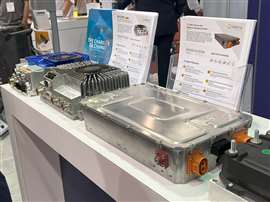 The acquisition of SMPC Technologies expands Delta-Q’s portfolio to include higher power, higher voltage charging solutions. (Photo: Becky Schultz)
Dayrit: That’s really part of the strategy… On the motor and controller side, we have a vast range of products from low voltage to high voltage. On the charger side, that wasn’t the case. So, the acquisition of SMPC broadens the range to offer not only high voltage, high power, but also new markets like EV charging stations.
And then the other acquisition, Stercom, broadens it out even more because they offer three different categories of product offerings. One is the onboard chargers. There’s going to be some comparisons between some of their offerings and what SMPC brings – somewhat different, but somewhat the same. They also have another category that does battery management systems [which are] complementary to our system-based approach.
And then they also offer a battery energy storage category. So now you start thinking of infrastructure. You start thinking of power needs that could be complimentary to the grid. It opens the door to other markets that still revolve around the ecosystem of product offerings that the group provides.
That’s really the strategy – to stay within the ecosystem but expand the offerings and the markets and the applications outside of the current ones.
Q: How are you working to present these expanded product offerings to customers?
Dayrit: A good example that we actually just went through [was] with one of our large customers in the material handling space. Rahul was part of that discussion because what they were doing was mobile battery energy storage, but they were utilizing power electronics that SMPC develops – the DC-DC, higher power stuff that neither Delta-Q or Zivan [a specialist in high-frequency battery chargers] had the capabilities of doing or really focused on in the past.
So, it’s melding [capabilities] that we didn’t have before and offering solutions for a gap in what the market is looking for. It’s looking for commonalities but also looking for other pathways to sell product that we didn’t sell in the past. It’s giving us more headway to grow while still keeping the core ecosystem of products intact.
Q: How are you working with the OEMs? Is it as an integrator, as a component supplier for existing solutions or all of the above?
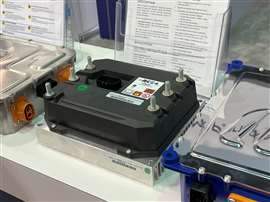 The Zapi ACE4 inverter can be packaged with other products in the Zapi Group ecosystem to provide an integrated solution. (Photo: Becky Schultz)
Dayrit: It’s all the above. It really comes down to the OEMs and their requirements. Some want us to provide the whole solution and be liable for that whole subsystem, which is fine, we have the capabilities to do that. We also have a company called 4E [Consulting] that does system integration. And we have a bunch of partners to rely on if they don’t want to utilize our internal system integration.
But we are starting to notice, especially in the off-highway space, they’re wanting more and more integrated solutions... So, SMPC and Delta-Q and Zivan, we started taking functions that operated discreetly or independently of each other and started to marry them inside the same package to offer more efficient solutions, more of an all-in-one multifunction component.
OEMs have told us: “We want to differentiate on the system level, or on the application level. Everything inside – make it easy for us. So, hold the liability of these subsystems and then we’ll depend on you more.” That’s what we’re starting to hear; that’s a trend. We’re hearing it heavily in construction and ag… Even in the material handling space, which is not really off highway, so to speak, they’re wanting more integrated solutions and components.
Q: Is that something that you’ve encountered as well, Rahul?
Baliga: Multiple times. In fact, if you look at some of our products that we have recently launched… it includes a variety of functions that 10 years ago used to be all independent functions or all independent blocks.
It does a couple of things for customers. One is it gives them a cost advantage when you bundle things into a single product. The other piece is it frees up space in their vehicle for them to do other things. We have had customers on the access side of the business [that] said we want a much smaller footprint so that we can put telemetry equipment in that corner or something along those lines.
That becomes a differentiating factor for us as a company when we are able to provide those bundled solutions, whereas our competitors may not be able to provide that. And more so when you start bundling functions, you start dealing across different departments, even within the engineering group, within that same company.
It gives us a larger footprint to work with within that organization. That’s the value proposition that we bring to the table as opposed to being a component supplier. We’re becoming more of a system solution provider to the OEMs as Delta-Q but more largely speaking as Zapi [Group].
Q: What do you see as the next steps for Zapi Group, and Delta-Q, in terms of the strategies that have been put in place?
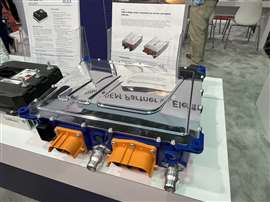 Inmotion is a Zapi Group brand that supplies inverters, electric motors, and industrial power electronics, such as the ACH3 high-voltage motor controllers. (Photo: Becky Schultz)
Baliga: For Delta-Q [and SMPC], a lot of our focus right now is on the integration efforts to ensure that the two companies are successfully integrated.
Plus, SMPC and Delta-Q have a very detailed and long road map In terms of variety of products on the low power, low voltage, all the way up to the high power, high voltage, and across various different functions – whether it be for onboard charging, DC-DC converters, vehicle to load inverters for communication controllers – that we are all working towards. We need to ensure we get those products released into the market.
The success of this is our primary focus at Delta-Q right now.
Dayrit: From the group perspective, we’re going to continue to focus on the system – continue to grow the system and make it more integrated. Because as more players come to market, it’s harder and harder to differentiate alone. The only way that we really could compete and bring that value is integrated solutions, and we have the right components to be able to do so. It’s just doubling down and placing our bets on solutions that will not be able to be easily copied by our competitors.
We have the brand recognition. We have the reputation in the marketplace. We have the performance metrics. It’s really now having our OEMs or our customers relying more on us than having [them] design on their own. Take the onus off the customer, let them focus and differentiate on what they need to focus on and let us do the rest.
POWER SOURCING GUIDE
The trusted reference and buyer’s guide for 83 years
The original “desktop search engine,” guiding nearly 10,000 users in more than 90 countries it is the primary reference for specifications and details on all the components that go into engine systems.
Visit Now


CONNECT WITH THE TEAM