Read this article in 中文 Français Deutsch Italiano Português Español
CATL Natra sodium-ion batteries pass stringent safety tests

11 September 2025
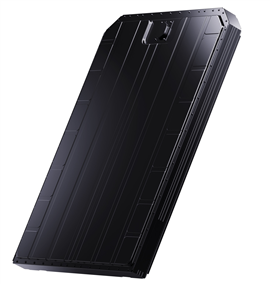 CATL Naxtra sodium-ion battery pack (Photo: CATL)
In April this year, CATL unveiled its new Naxtra sodium-ion batteries for electric vehicles and the Naxtra 24V Integrated Start-Stop Battery for heavy-duty trucks. Previewed together with the Freevoy Dual-Power (hybrid sodium/LFP anode) batteries, CATL hailed the launch as the start of the ‘Multi-Power Era’.
A series of media outlets are now reporting that Naxtra sodium-ion cells have passed China’s new national battery safety standards (GB 38031-2025, Safety Requirements for Power Batteries of Electric Vehicles), which should clear the way for mass production of the sodium-ion cells by the close of 2025.
The new standard aims to eliminate fire risks in electric vehicles at the source, with tests covering thermal diffusion, bottom impact and fast-charging cycles.
CATL stated that the technology marks the point where battery development has switched from ‘passive defence’, or designing battery tech to minimize fire risk, to ‘intrinsic safety’.
Sodium-ion batteries various benefits over lithium-based models. To start, sodium is far more common than lithium, helping to eliminate material sourcing bottlenecks. The cells have an energy density of 175 Wh/kg, comparable to LFP models, while retaining 90% of the usable capacity at -40C.
Additionally, with a peak charging rate of 5C the batteries are capable of achieving more than 10,000 charge/discharge cycles.
CATL has reported that second-gen sodium-ion cells, which have a provisional SOP date of 2027, can support a peak 12C recharging rate. This would be a new record for super-fast charging cells.
The Freevoy Dual-Power battery combines sodium-ion cells with CATL’s self-forming LFP anode technology. This is said to support five key features: dual high voltage; dual low voltage; dual structure; dual thermal management; and dual thermal runaway safety protection.
The self-forming LFP anode allows cells to achieve higher power storage capacities to where combined systems could potentially achieve more than 1,000 Wh/L.
Chery Automobile is set to be the first OEM customer for the Naxtra batteries, although the tech could be rolled out across CATL’s network of ‘Chocolate’ battery swap stations. The company has targeted opening 1,000 locations by the end of 2025.
POWER SOURCING GUIDE

The trusted reference and buyer’s guide for 83 years
The original “desktop search engine,” guiding nearly 10,000 users in more than 90 countries it is the primary reference for specifications and details on all the components that go into engine systems.
Visit Now
STAY CONNECTED



Receive the information you need when you need it through our world-leading magazines, newsletters and daily briefings.

CONNECT WITH THE TEAM