Read this article in 中文 Français Deutsch Italiano Português Español
Milence outlines electric HD truck charging plans

30 September 2026
Backed by a series of OEM truck manufacturers, Milence has been given the task of creating a recharging network for the company’s electric trucks
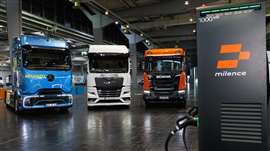 Demonstration area for new Milence MCS sytem at IAA Transportation (Photo: Milence)
The company now known as Milence was formed in 2022 as Commercial Vehicle Charging Europe. It remains a standalone venture co-owned in equal part by Daimler Truck, the Traton Group and Volvo Group.
The company is responsible for development of a charging network to support electric heavy-duty trucks. Its first recharging site was opened in Venlo, the Netherlands, in late 2023. Currently there are 40 locations in nine European countries with an estimated 200 high-power charging points.
BESS, or no BESS
At IAA Transportation 2026 in Hanover, Germany, the company previewed its MCS, or Megawatt Charging System. Delivering up to 1,000 kW of power via Alpitronic’s HYC1000 system, it is put forward that the system can recharge depleted truck batteries within the mandated 30 to 45 minute driving break time.
It’s a great plan, but bottlenecks in grid power delivery could impact such high recharging levels. “Of course, it will need a good grid connection,” says Ruud Heijsman, PR and Events manager at Milence. “We currently have three sites in Europe with megawatt chargers and none are using battery storage [to support power delivery].
“On the other hand, we have other locations which don’t have megawatt chargers, but do have a BESS [battery energy storage system] to ensure we can support customer demand.”
Site issues
Milence held demonstrations of its MCS at the IAA fair, but Heijsman explained that as grid power supplied to the Deutsche Messe location was not sufficient, the company had installed a 2 MW BESS for the demo.
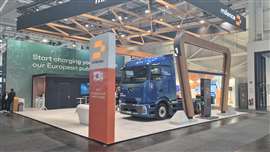 Milence stand at IAA Transportation 2026 (Photo: Power Progress)
Continuing, Heijsman compared the trade fair setup with that of an existing logistics company truck hub that needed a recharging installation but required a BESS due to insufficient local grid capacity. When looking at the selection of new sites, he added that Milence is free to choose locations on major highways which have both the physical space and grid capacity to support high-speed recharging.
“Location, space, grid capacity. Those are the indicators for us that will support a successful megawatt charging system installation,” he explained.
Grid hardware
The location with the highest grid power is not necessarily the best option; it’s more important to have deliverable capacity, energy which has yet to be earmarked by other businesses or households.
“We work with the grid operators to find the best connection, the best [energy] availability,” says Heijsman. “We can plan to use a particular location if a grid connection will follow in a couple of years. But we would need a guarantee that this will happen.”
He says that securing grid capacity is more difficult in some countries, while not identifying exactly what makes the process more problematic in these areas. But he points out that Milence will not invest in locations which don’t offer the potential for growth – essentially capacity to support additional recharge points.
Market demand grows
As noted earlier, the first Milence e-charging site was at Truck Parking Venlo, a massive location on the A67 highway on the border between the Netherlands and Germany. The facility has recently expanded to accommodate a maxium 390 HGVs.
 Milence charging hub at Venlo Truck Park in the Netherlands (Photo: Milence)
“We started with four 400 kW CCS chargers,” recalls Heijsman. “That was increased to eight and now there are 12 chargers. There is a good grid connection system, but we have added a BESS to support charging; we’re looking at other solutions to support further expansion.”
That a BESS was needed at the Venlo site (and that there is no MCS installation) highlights the problems of offering heavy-duty recharging at legacy locations. At time of press, Milence has three MCS megawatt chargers in operation. The first was installed in Belgium at the Port of Antwerp-Bruges. Others are in Zwolle, the Netherlands and Lanvetter, Sweden.
Focus on recharging
The alternative to truck recharging is battery swapping, a system which is already proving very popular in China.
Heijsman: “That’s not something that Milence is looking at. We’re focusing on recharging.” Asked if that has anything to do with Daimler Truck/Mercedes-Benz Trucks or other partners not offering a vehicle which supports battery swapping, he says it’s more a case of how the regional market has developed.
He also points to mandated rest periods being an ideal time to recharge, both the driver and the truck. “I don’t know how rest periods are managed in China or other countries, but in Europe drivers have to take breaks and with MCS-level recharging rates, even short stops will be enough time to recharge the battery packs.”
POWER SOURCING GUIDE

The trusted reference and buyer’s guide for 83 years
The original “desktop search engine,” guiding nearly 10,000 users in more than 90 countries it is the primary reference for specifications and details on all the components that go into engine systems.
Visit Now
STAY CONNECTED



Receive the information you need when you need it through our world-leading magazines, newsletters and daily briefings.


CONNECT WITH THE TEAM