Read this article in 中文 Français Deutsch Italiano Português Español
The future of HD truck battery-swap technology in Europe

03 September 2026
Jens-Olav Jerratsch, CEO and co-founder of EHaul, talks with Julian Buckley about the benefits of battery-swap tech for heavy-duty electric truck applications
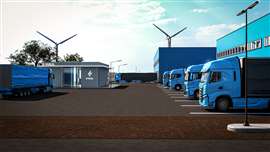 Concept for an EHaul battery swap and truck recharging location (Photo: EHaul)
In June this year, Power Progress reported that CATL, China’s battery manufacturing giant, and European energy provider Octopus, were to jointly develop the Swaptopus network to support a European commercial vehicle battery swap business.
For its part, CATL has some not inconsiderable experience in the market. In China, the company operates the Choco-Swap battery swap network for passenger vehicles – the name comes from battery packs looking a little like chocolate bars. The Qiji Energy brand offers the same service for heavy-duty trucks.
As of May 2026, it was estimated that there were 1,650 Choco-Swap locations operating in 127 cities across China. This was up from around 700 outlets in October 2025. At time of writing, there were about 300 Qiji locations, with plans to expand that to nearly 900 sites by the end of 2026. By 2030, the goal is to cover about 80% of China’s logistics corridors.
Reasons for battery swapping
Coming back to Europe, there are other players already active in the battery swap market. One of these is EHaul, a spin-off from the Technische Universitat Berlin, which is currently developing fully-automated battery-swap stations intended to support heavy-duty electric trucks.
Speaking with Power Progress, Jens-Olav Jerratsch, CEO and co-founder of EHaul, started by pointing out that the group has been working on a battery swap solution since 2017. “When we first looked at how battery-electric trucking works, we immediately started looking at battery swapping; back then, we couldn’t predict megawatt charging. So really, we were just looking for a feasible solution to get energy onto a truck.”
At the same time as getting packs onto trucks, Jerratsch said that battery swapping can also address grid congestion. “A 1 MW charger will take around 30 minutes to recharge a 500 kW battery pack. Pack chemistry has advanced a lot, but recharging at these higher rates still cannot match the five minutes needed to complete a swap.”
“Then there’s the question of where that energy is coming from, what is supporting that 1 MW of power that needs to be delivered to each truck at a given location?”
In answer to his own question, Jerratsch says that grid power alone will not be sufficient to support a large truck recharging facility. Instead, power will have to be delivered via onsite batteries acting as a buffer.
“These batteries will be required anyway to store energy collected at times of low demand; it’s a type of peak shaving. They can also be used to balance recharging rates.”
OPEX instead of CAPEX
Keeping in mind the concerns about energy delivery for recharging, another issue is the high upfront cost of battery-electric trucks. It is broadly assumed that TCO, or total cost of ownership, will offset this adoption barrier (largely based on a lower per-kilometer operating cost versus diesel, etc.) to where a favorable cost balance is achieved over the working life of the vehicle.
 Jens-Olav Jerratsch, EHaul
This, though, does not work for smaller companies which don’t have the upfront capital to invest in a battery-electric truck, no matter what the TCO benefit.
“It’s more of an upfront CAPEX issue than a TCO issue,” said Jerratsch. “With our battery-as-a-service, instead of financing the battery within the purchase price of the truck, you finance it with every kilometer travelled, every kilowatt hour which goes through the drivetrain. Switched to an OPEX model, final cost will depend on utilization of the truck.”
With this, Jerratsch is essentially advocating a battery leasing solution which he believes would reduce the up-front cost preventing adoption of electrically-powered trucks.
Battery swap process
Looking at how a battery swap location would work, Jerratsch described it as a “warehouse solution.” The battery packs would be held in racks where they would be recharged before fitting. The recharging process would be monitored, looking at such factors as state of charge and temperature.
A driver would arrive at the location and, either based on number plate recognition or a touchscreen interface, the truck model would be identified. The fully-automated system would first remove the battery pack and then pick the correct replacement and complete the installation.
“It would be very much like a carwash,” said Jerratsch by way of comparison. “You pull in and the system completes the service. The full process would take about five minutes.” He added that each location would have the capacity to carry out battery swaps for between 60 and 70 trucks each day.
As for location, Jerratsch has two use cases. The first would be at rest stops on major routes, where trucks could arrive ad hoc – to add further flexibility, these sites could also provide recharging services. The second would be to have locations in closer proximity to company hubs.
“This would address grid congestion,” he says. “The hub can recharge the first 10 trucks, but what about the others which also need recharging when capacity has been used? It’s another case where battery swapping would complement recharging, not replace it.”
Battery specifications
According to Jerratsch, EHaul has had discussions with truck OEMs about battery swapping, how the systems should function. It has been hard work, he says, due to cable charging of onboard battery packs being the collective development path.
“[European truck OEMs] have been reluctant to put a lot of effort into battery swapping,” Jerratsch noted. “But we did resolve this, at least in part, through development and publication of the DIN SPEC 91533 specifications.”
Released in April 2026, this covers standardization of the vehicle/battery interface and battery pack dimensions. But the standard is ‘adoptable’, rather than compulsory. That said, a group of big names has backed the move, including CATL, DAF Trucks, Daimler Truck, DHL Group, Iveco, Trailer Dynamics and Traton.
“It’s a first step in defining the European battery swap environment,” said Jerratsch. “We have designed our second-generation battery swap station around the DIN SPEC 91533 guidelines, as these cover functionality of the location and how it will interact with trucks designed to meet the specifications.”
The problem here is that no European truck OEM is currently producing any heavy-duty truck which supports battery swapping. Jerratsch says that this has made it difficult to make a case for the business model. But he believes that CATL’s Swaptopus, together with a test using DeepWay battery-swap trucks from China, will motivate truck makers to develop those vehicles.
“The specifications will allow different stakeholders, truck manufacturers, battery manufacturers, fleet operators, infrastructure equipment manufacturers, to all integrate into an ecosystem that hasn’t simply been defined by the first or the biggest operation.”
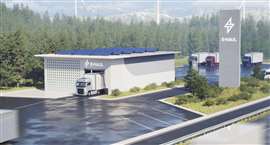 EHaul sites would be selected for ease of access (Photo: EHaul)
Chinese trucks
With no European trucks having battery swapping capability, Jerratsch is asked whether he foresees his first customers being a stream of trucks imported from China which have the necessary functionality.
“Honestly, our vision for the system is to support fleet operators. It’s up to them which trucks they choose to purchase. If only trucks from China offer the capability and they want that capability, then that’s where the trucks will come from. But our goal is to cater to all trucks which meet the standard.”
Interestingly, the standards only outline connectivity and positioning of the battery pack on the vehicle (generally underneath or behind the cab). This, though, could allow European OEMs to define their own parameters about battery placement and size, with packs produced to suit regional routes.
Close competition
“We’re not going to build a network upfront and hope that customers come. We’re going to build the stations as individual projects for customers who would like to have them,” said Jerratsch.
This will see companies partner with EHaul to support development, but the sites will still remain open to other trucks. There’s also the potential for licensing to support expansion of the network in other countries and regions.
The tech would appear to lend itself to the United States, where distances have so far kept battery-electric trucks within California and other western states.
“I think the US has great potential as a future market, but as a startup we’re not really looking that far into the future. Germany and Europe are very supportive of electrified trucking. In the US, recent policy does not support electric trucks and even the trucks are not easy to adapt.”
Closing with a look at how a startup might fare in the face of competition from the likes of CATL, Jerratsch is pragmatic in his response. “We operate at a certain level of risk, certainly. But once you get past the first 40 or so locations, the network would give us greater market reach, better market resilience and partner opportunities. That should give us the space and time to find our spot in the market.”
Battery swapping will better support the transition
“If we really want to transition the logistics industry to electrification, we have to change the current model for truck recharging,” said Jerratsch.
Continuing, he says that while larger companies have hubs which can be used for recharging, he estimates that between 80 and 85% of logistics operators in Germany have 10 or fewer trucks and possibly no hub locations.
“These companies cannot invest in electric trucks with an incorporated battery pack, or depot charging infrastructure. The top 20% of logistics companies should invest in their hubs, maybe using renewable energy for recharging. But to support a true transformation, we need something beyond just depot charging and that’s where battery swapping comes in.”
POWER SOURCING GUIDE

The trusted reference and buyer’s guide for 83 years
The original “desktop search engine,” guiding nearly 10,000 users in more than 90 countries it is the primary reference for specifications and details on all the components that go into engine systems.
Visit Now

CONNECT WITH THE TEAM