Read this article in 中文 Français Deutsch Italiano Português Español
Toyota launches new fuel cell route bus

05 October 2026
New bus jointly developed with Isuzu Motors Ltd.
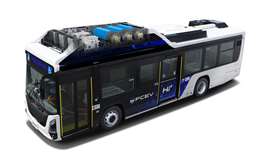 Toyota said by compactly mounting the fuel cell system on the roof of the new Sora bus, vehicle maintenance by bus operators has been made easier. (Illustration: Toyota)
Toyota Motor Corp. regards hydrogen as an important energy source in realizing a carbon-neutral society. To that end, the company recenty launched a new edition of Sora, its hydrogen fuel cell route bus.
Toyota launched the first-generation Sora (an acronym for sky, ocean, river and air) in 2018, offering a new option for route buses through clean, quiet fuel cell-powered operation. With the introduction of the upgraded Sora, Toyota said it will continue to contribute to realizing a hydrogen society by promoting the use of hydrogen in public transportation.
The new Sora bus was jointly developed by Isuzu Motors Ltd. and Toyota as part of efforts to make zero-emission route buses available. It combines Isuzu’s battery-electric full-flat route bus platform with Toyota’s fuel cell system, further advancing the environmental performance and usability of route buses.
Toyota said the fuel efficiency of the new bus has been improved by more effectively using the fuel cell and a large-capacity lithium-ion battery. Compared to the first-generation Sora, the total hydrogen tank capacity has been reduced by about 20%, while the cruising range has reportedly been extended by about 100 km to over 300 km, meeting the operational requirements of transit buses.
By building on fuel cell technology developed through previous efforts, Toyota said it adopted a compact fuel cell stack for commercial vehicles with increased output and durability, contributing to smoother, more stable operation. In addition, a new large-capacity hydrogen tank for commercial vehicles was developed, and by compactly mounting the fuel cell system on the roof, vehicle maintenance by bus operators has been made easier.
The company said the vehicle can be fully refueled with hydrogen in about 10 minutes, supporting operations that require high vehicle utilization. The vehicle complies with a new high-speed filling standard; when compatible hydrogen stations are deployed in the future, refueling time can be reduced by about half, said Toyota. In addition, by connecting an external power supply unit, the vehicle can be used as an emergency power source during disasters.
The vehicle is equipped with safety features such as an Emergency Driver Stop System (EDSS), linked with a Driver Status Monitor (DSM). If the system detects that the driver is experiencing a problem, the vehicle decelerates and stops, automatically applies the parking brake after stopping, and helps ensure safety even on slopes.
The passenger compartment uses a full-flat floor with no steps, creating a space where all passengers, including those using wheelchairs or strollers, can move more safely and smoothly.
Four bus variants ― two for urban use and two for suburban use ― with different seat layouts are offered to meet a variety of operating needs.
Toyota said it has been working with many partners in producing, transporting, storing and using hydrogen to promote the widespread adoption of hydrogen mobility.
The company introduced its first fuel cell electric vehicle, the mid-size Mirai passenger car, in 2014 and has sold it in more than 30 countries and regions. It is still avaiable in select regions. Since 2019, Toyota has supplied fuel cell systems that generate electricity from hydrogen, and has provided more than 3,500 such systems to over 100 customers worldwide for applications such as buses, rail, and stationary generators.
In partnership with other companies, Toyota has also developed hydrogen cartridge and hydrogen sauna, promoting decarbonization in areas of everyday life as well.
POWER SOURCING GUIDE
The trusted reference and buyer’s guide for 83 years
The original “desktop search engine,” guiding nearly 10,000 users in more than 90 countries it is the primary reference for specifications and details on all the components that go into engine systems.
Visit Now
STAY CONNECTED



Receive the information you need when you need it through our world-leading magazines, newsletters and daily briefings.

CONNECT WITH THE TEAM