Read this article in 中文 Français Deutsch Italiano Português Español
Echo extends beyond outdoor power

02 November 2026
In late August, Echo Inc. hosted its annual Power-On-Athon event at its North American headquarters, in Lake Zurich, Ill. – an event designed to show customers and others its manufacturing and distribution operations across its 600,000-sq.-ft. campus, as well as highlight the newest additions to its expansive Outdoor Power Equipment (OPE) portfolio.
“We’ve been on this campus since 1985, and now we bought the property across the street, as well, to help support our growth,” said Wayne Thomsen, vice president of Marketing and Product, Echo. “We have about 1,100 employees at peak here – probably 800 or so in the assembly facility. We are the largest employer in Lake Zurich.”
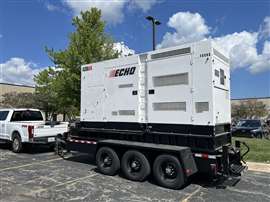 The 400-kVA DGK400F is both the largest and newest model in the generator range. (Photo: Becky Schultz)
The event included a facility tour, new product presentations and opportunities for hands-on demos. For the landscape contractors in attendance, a lineup of 11 new OPE debuts – including the PB-9510, a monster of a backpack blower equipped with a 79.9cc two-stroke gasoline engine generating 56N force, 1,200 cfm and up to 230 mph of airspeed – proved irresistible.
Yet, rather than OPE, positioned at the entrance to the main tent and demonstration area were select representations of Echo’s Industrial Power Equipment (IPE), highlighting the company’s newest product segment.
“Echo IPE came to life last June,” Thomsen noted. “However, we’ve been in North America for about 20 years with our range of generators.”
Mobile diesel generators and welders were previously marketed under the Shindaiwa brand. Now, that brand is limited to select applications and markets.
“We’ve consolidated under the Echo brand. It’s more well known and we’re able to leverage the power of that brand within this market,” Thomsen explained. “But as far as the equipment, our experience with it – it remains the same as it has been for the last 20 years.”
A history of durability
Since 1972, Echo Inc. has served the North American market as an operating company for Japanese manufacturer Yamabiko. While the focus has remained largely on OPE, its IPE division has grown steadily and now encompasses mobile diesel generators from 7 to 400 kVA; light towers in 3-, 6- and 8-kW configurations; and diesel-powered welders with single and dual welder capabilities.
Models within the IPE portfolio are engineered for rugged applications in challenging environments, with heavy-duty steel construction and intuitive controls. “Our OPE product is known in the market as very durable, high power performance and very easy to use,” said Thomsen, “and we bring those elements over to IPE.
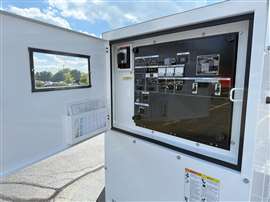 The IPE portfolio is designed for ease of operation, with most models incorporating simple, intuitive analog controls. (Photo: Chad Elmore)
“When we talk about durability, we want it to be more than us just saying they’re durable,” he continued. “Our warranty rate on our products is less than 1%, and it has been that way for OPE for 40+ years. On IPE, I think we’re less than a half a percent. So, our warranty level is very, very low, which suggests that the products are really holding up in the market.”
“They really are extremely durable,” Ryan Fredrickson, senior product marketing manager at Echo, said of the generator range. “We also make sure that they’re very easy to use. You’ll notice a lot of them have a very simple [analog] control panel, because especially in a rental environment, even in a construction environment, people aren’t generator experts when they need to go turn this on, use it, turn it off. So, we make sure that we supply that.”
Vertical integration throughout manufacturing means the control panels, alternators and most other generator components are all developed in-house.
“With the engine, we do go to outside sources, and we tend to partner with ones that we have identified, and customers have identified, as the most reliable and durable equipment,” said Fredrickson. “We partner with Kubota for the small engines and then Isuzu on the large engines.”
Differentiating features
A unique feature of the IPE line is Simul-Phase Technology. While many generators will output both three-phase and single-phase power, it requires plugging into a separate transformer to convert back and forth between power types, Fredrickson pointed out. Simul-Phase, on the other hand, gives users both power types at the same time directly from the generators.
In addition, he noted, “Typically, [generators are] only going to have the three-phase breaker, whereas we have a single-phase and a three-phase breaker… Above and beyond that, you can prioritize which trips first. If it gets overloaded and you want to prioritize the three-phase power, like if it’s [powering] a pump, it will trip the single phase first. Or if you have something critical on the single-phase circuit, it will trip the three phase first and keep the other one running.”
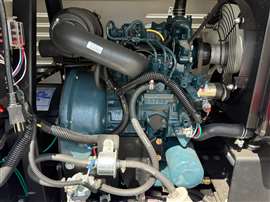 For IPE, Echo partners with Kubota for small engines and Isuzu on the larger engines. (Photo: Chad Elmore)
S.E.T. Smart Emissions Technology is yet another proprietary feature. “When generators are used, they’re often not used to their full capacity. That can cause issues with the emissions equipment so [it] becomes less reliable,” said Fredrickson. “So, we developed S.E.T. and put it in as standard for all of our generators 70 kVA and above.”
The technology detects low loads and automatically introduces a small, controlled electrical load to the generator that raises the operating temperature and forces the engine and its emissions control system to reach and maintain optimal performance. This helps to minimize the risk of wet stacking while providing added compliance protection and reliability for units during light or underloaded operation.
Ultra-quiet operation is yet another advantage of the IPE line. “Our [generators] are generally equal to or quieter than any of the competition in the marketplace,” Fredrickson asserted.
Noise is controlled using insulated panels, a tuned muffler and an airflow design that is intended to reduce sound. For example, on the DGK400F, Echo’s largest generator, air-bending dampers help to reduce sound levels to approximately 68 dBA at no load and 69 dBA at full load.
Newest and largest
The DGK400F is both the largest and newest model in the generator range. Introduced in January 2026, it produces 400-kVA continuous output (three phase) and is powered by a 15.681 L Isuzu 6WG1X Tier 4 Final turbocharged diesel rated 475.1 hp at 1,800 rpm (60 Hz).
The new unit can deliver heavy-duty prime and standby power for running multiple high-load machines simultaneously.
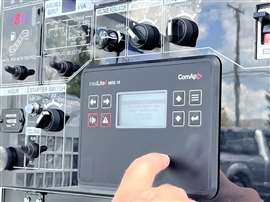 Echo partners with third-party control system providers to enable capabilities such as equipment monitoring via telematics. (Photo: Becky Schultz)
“For example, a 400 kVA could handle a much larger entertainment venue, like a full-size concert. It’s also used on construction sites for tower cranes… as well as a larger construction site where they need to run a number of pumps for dewatering,” Fredrickson commented.
Data center construction is another common application for the DGK400F. Echo is also exploring prospects for the generator to potentially serve as part of a microgrid used to power these and other mission-critical applications in future.
“We’re doing a lot of different R&D in conjunction with our parent company Yamabiko in Japan, and that definitely includes microgrids, where it might include a diesel generator, a solar array as well as a… battery energy storage system,” said Fredrickson. “Right now, we’re doing testing in other countries such as Australia and Europe to validate the concept. After that, then we would certainly make it available commercially in the U.S.”
The objective is to offer a fully integrated package, or to be able to smoothly integrate into the microgrids the data centers already have. “[Our] approach is to make it very simple to add those additional inputs,” said Fredrickson, “and then put them into the same control system so that they can manage their microgrid.”
Shedding new light
The IPE division entered a whole new category this year with the addition of light towers. Echo acquired the assets from South Carolina-based Taylor and Ard Equipment LLC in January 2026.
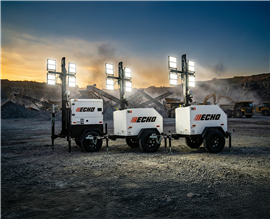 Echo’s new line of light towers includes 6- and 8-kW configurations. (Photo: Echo Inc.)
The 3-, 6- and 8-kW configurations were introduced “right out of the gate.” They incorporated LED lights rated at 216,000 lumens, as well as a rugged vertical mast with a manual self-braking winch, mast brake and nearly 360-degree rotation to allow crews to easily aim the lights without repositioning the unit. Power is provided by Kubota diesels with runtimes of up to 310 hours.
Shore power comes standard on all three models, meaning they can operate on standard 120V AC, 15-amp grid power without running the engine. “If you’re in an area where you have just a household plug, you can plug this light tower into that outlet and power it without running the engine or burning any fuel. So, these can be used indoors,” said Fredrickson.
On larger models, two light towers can be connected and powered using a single engine, meaning further fuel savings, emissions reduction and less wear on the engine.
More to come
After the successful addition of the light towers, Echo is exploring possibilities to grow the IPE segment even further.
“Like the acquisition that we made with the light towers, we’re looking at expanding our category portfolio,” said Thomsen. “We continue to look at more and more opportunities… to add value for our customers.”
The company also continues to investigate new technologies. For example, Echo now offers optional third-party control systems through partnerships with companies like ComAp to provide paralleling control as well as telematic solutions.
“If it’s a smaller scale operation, we can set up ComAp [and other brands] such that it does broadcast that information to the network and then they can use the system to monitor their equipment,” said Fredrickson.
The overarching mindset is to provide more solutions that can deliver the value Echo customers have come to expect.
“As Ryan pointed out, we’re looking at different technologies to support the product. There’s also a lot of stuff in R&D right now that we’re working on,” Thomsen stated. “I think you’ll continue to see more and more exciting new stuff from Echo in the future.”
POWER SOURCING GUIDE
The trusted reference and buyer’s guide for 83 years
The original “desktop search engine,” guiding nearly 10,000 users in more than 90 countries it is the primary reference for specifications and details on all the components that go into engine systems.
Visit Now
CONNECT WITH THE TEAM