Read this article in 中文 Français Deutsch Italiano Português Español
AMS Barging adds new diesel-electric tanker to its fleet

21 October 2026
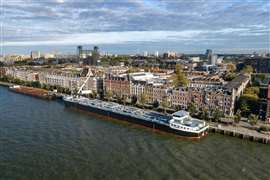 Felicitas is a 9,000 cubic metre tanker (Photo: AMS Barging)
AMS Barging, an inland shipping company based in the Netherlands, has added a new diesel-electric tanker to its fleet based in Rotterdam.
The 135-metre tanker was designed by RensenDriessen Shipbuilding, while fitting out was completed by Breejen Shipyard.
With a capacity of approximately 9,000 cubic meters, the Felicitas features 12 cargo tanks, a dual piping system, two mass flow meters, a nitrogen generator and a bunker boom. Cargo pumping capacity is 1,800 cubic meters per hour.
In addition, the tanker is designed to accommodate future modifications for methanol bunkering.
The Felicitas has three CAT GP-C 32 diesel engines, plus a CAT C7.1 gen set. The engines were supplied through Industrial & Marine Solutions – Greenpower. All engines are Stage 5-compliant to reduce emissions and particulates. A Stage 5 rather than IMO certification is used due to the tanker working on inland waterways.
The incorporation of methanol bunkering points to a future plan to switch the engines to a fuel type which can further reduce emissions. Considering that diesel engines use compression ignition and methanol uses spark ignition, it would appear that this would require a complete replacement of the cylinder head.
But Igor Jansen, owner of AMS Barging, said that this is not necessarily the case. “Updating the engines would depend on the methanol combustion technology. If we were to convert the CAT C32 engines to 100% methanol using spark ignition, this would indeed require significant modification, including replacement of the cylinder heads, changes to the compression ration, fuel injection and engine management systems.
However, a methanol dual-fuel solution using diesel pilot ignition could potentially retain much of the existing engine architecture.”
Beyond this, Jansen believes that a larger challenge would be maintaining Stage 5 compliance.
“Converting them to methanol would change the certified engine configuration, meaning Caterpillar would need to address the type approval for the modified engines.”
Caterpillar currently offers dual-fuel tech for its larger MaK engines, but Jansen said he’s not aware of an approved methanol conversion package for the C32 model.
Jansen said that this will be something the company will have to discuss with Caterpillar. “There is no single, clear-cut answer, it simply hasn’t been done yet,” he explained. “As soon as methanol-fuelled engines become available that are also Stage 5-certified, you can switch to methanol.”
POWER SOURCING GUIDE
The trusted reference and buyer’s guide for 83 years
The original “desktop search engine,” guiding nearly 10,000 users in more than 90 countries it is the primary reference for specifications and details on all the components that go into engine systems.
Visit Now
STAY CONNECTED



Receive the information you need when you need it through our world-leading magazines, newsletters and daily briefings.

CONNECT WITH THE TEAM