Read this article in 中文 Français Deutsch Italiano Português Español
New ECTMarine-designed workboat enters service on the Dead Sea

30 October 2026
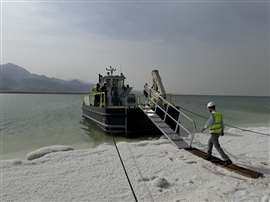 New workboat has entered service on the Dead Sea (Photo: ECTMarine)
ECTMarine has delivered a new workboat to the Arab Potash Company (APC). That in of itself is not necessarily newsworthy, except that this vessel will be working on the Dead Sea, one of the harshest marine environments in the world.
Located about 400 meters below sea level, the Dead Sea is reported to have a salinity of around 34%, 10 times that of ocean water. Designed and built in the Netherlands, the workboat was tailored to manage these conditions.
The Workboat 104 features a forward wheelhouse, an open working deck and a knuckle-boom deck crane. The vessel has a hull and deck which allows it to be transported by road on a standard flat rack.
“The Dead Sea is not a normal place to operate a boat, commented Abdallah Ghammaz, project manager at Alghanem, the company representing APC.
“The brine is extremely dense and corrosive, the site is remote and the vessel has to be moved by road and lifted in by crane. We needed a workboat built around those conditions and around the tasks APC performs on the salt ponds. ECTMarine took the time to understand that before they started designing.”
The drivetrain also had to be designed that it would protect the local environment.
“As the brine in the area is also the product being mined, cooling cannot use the water the vessel is sailing in. That is why the engines are air cooled,” said Jesse Boerma, commercial director at ECTMarine. “The complete system is adapted for use on the Dead Sea, the drivetrain and propulsion system and the cooling unit.”
The workboat completed its factory acceptance tests in the Netherlands over summer 2026. The two-day trials included demonstrations of the vessel’s systems, operating modes and configurations.
The new addition was then shipped to Jordan on a flat rack to the launching point next to the evaporation ponds. A mobile crane with a double-spreader bar rig lifted the vessel from the trailer into the brine water. Following further local tests, the ship has now entered regular service.
“The tests confirmed that the vessel does what it was designed to do, in the real conditions on the ponds. Seeing it float on the brine for the first time and then pass every test was a proud moment for everyone involved,” said Ghammaz.
POWER SOURCING GUIDE

The trusted reference and buyer’s guide for 83 years
The original “desktop search engine,” guiding nearly 10,000 users in more than 90 countries it is the primary reference for specifications and details on all the components that go into engine systems.
Visit Now
CONNECT WITH THE TEAM